|
S26 Solidarity Action
Report and Supporting Documents
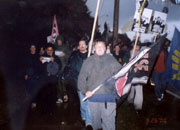 September 26, or S26, the day the IMF and World Bank would hold their fall series of meetings, represented another opportunity to push for the abolition or drastic reform of these international financial institutions. In Prague, Czech Republic where the global financiers met, vigourous actions were planned and carried out, leading to a fiery victory for global justice campaigners when the IMF decided to end their meetings one day early. Although, some collectives decided to engage the police barriers directly with force, most demonstrators representing the rainbow hue of human interests against corporate rule, remained peaceful. September 26, or S26, the day the IMF and World Bank would hold their fall series of meetings, represented another opportunity to push for the abolition or drastic reform of these international financial institutions. In Prague, Czech Republic where the global financiers met, vigourous actions were planned and carried out, leading to a fiery victory for global justice campaigners when the IMF decided to end their meetings one day early. Although, some collectives decided to engage the police barriers directly with force, most demonstrators representing the rainbow hue of human interests against corporate rule, remained peaceful.
Meanwhile, solidarity with the demonstrators in Prague was expressed by fellow activists around the world. Led by Jobs with Justice, solidarity actions in the US took the form of autonomous actions against corporate targets around the country.
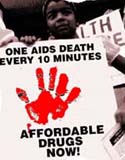
In Boston, the giant pharmaceutical multinational, Pfizer, emerged as the choice target for both its profiteering on AIDS-related drugs in Southern Africa and its price-gouging in the US. The role of western pharmaceuticals in the AIDS crisis, coupled with the crushing debt owed by Southern African countries, linked in profound terms the evils of the present global economic system that puts profits over people and debt before life.
The first meetings to plan the S26 event were held at the Jobs with Justice offices in Jamaica Plain, before moving to the Oxfam America offices in downtown Boston when that organization joined the efforts. Jubilee 2000 and Search for a Cure, along with the Africa AIDS group of BGAN, infused the "Drop the Debt! Drop the Prices!" rally and march to Pfizer's Cambridge headquarters with its theoretical grounding.
A listserv was also established for this effort, [email protected].
Pictures
 |
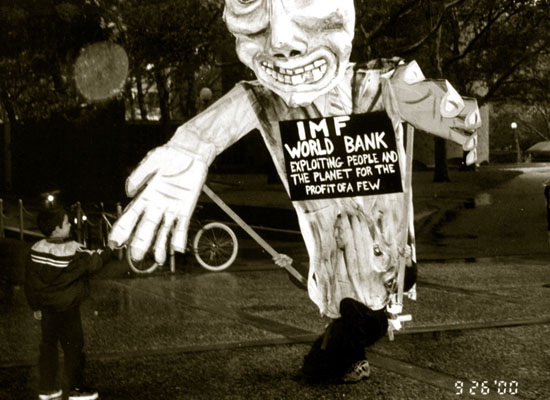
Greasy Bastard makes a young friend |
|
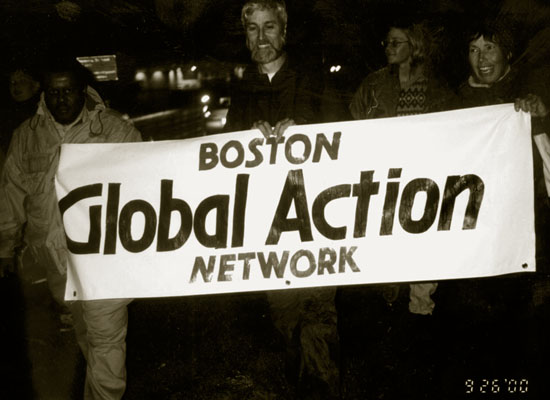
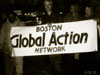
Trotting out the banner |
Background Information

|
Flyer Posted for March on Pfizer (Word 97/98) |
 |
Boston Activists ACT UP on Prague Solidarity Day (Summary Article submitted to IMC) |
|
Protesters Take Aim at Pfizer (Sept. 29, 2000 - The MIT Tech) |
|
Letter of Support from Treatment Action Campaign |
|
Fact Sheet on AIDS, Debt, and Pfizer |
To: Boston Comrades,
Sanibona from Treatment Action Campaign in South Africa.
We bring a message of support for your actions today. We take special note of your highlighting Pfizer and its role in profiteering from drugs important in treating conditions closely associated with HIV/AIDS in South Africa.
We welcome your action highlighting the profiteering of Pfizer, and support for our demands that:
- Pfizer immediately reduce the price of fluconazole to an affordable level for all indications in all developing countries. This is considered to be R 3.00 per 200 mg tablet in South Africa, instead of the R 28.00 presently charged in the public sector.
- Pfizer remove all restrictions from existing flouconazole donation offer to the South Africa, including the two-year time limit, and the limited use for the indication of cryptococcal meningitis.
- Pfizer play a constructive and active role in pressuring other pharmaceutical manufacturers to drop their legal proceedings against the South African government's legislation thereby allowing the speedy implementation of compulsory licensing of essential treatments for HIV and AIDS,at nominal or no costs.
- Pfizer work actively within Pharma International to assist in either lifting all trade restrictions on essential drugs for HIV/AIDS and related treatments in all developing countries, and to further support local, sustainable production of these drugs, especially in Africa where the epidemic is concentrated and the resources are not available.
We wish well in your action, and salute your solidarity.
Viva Access to HIV/AIDS Treatments Viva.
From the Treatment Action Campaign, South Africa
Fact Sheet on AIDS, Debt, and Pfizer
Compiled for S26
The AIDS Crisis in Africa
- At least 22.5 million people in Africa are living with HIV, and 10 Africans become infected every minute.
- 2 million Africans died of AIDS last year.
- By 2001, there will be 13 million AIDS orphans in Southern Africa alone.
- In Zimbabwe, 26% of the adult population is infected with HIV; in Botswana, 25%.
- 1,500 more people are diagnosed with HIV in South Africa each day.
- Average life expectancy in Zambia was 54 in 1991; today it is 44 and falling.
IMF, World Bank, and Debt
- Sub-Saharan African nations collectively owe more than $227 billion in debt to the IMF, World Bank, and the western nations that control them. Now, the cost of paying off that debt prevents governments from spending on vital health needs, including the fight against HIV/AIDS.
- The vast majority of this money was spent on projects that benefited rulers and elites, not common people. As Chatinkha C. Nkhoma of Malawi has said, the money went to projects "like buying arms to kill each other for the sake of the Western Cold War."
- On average, African countries spend twice as much on debt as on health care.
- The UN Development Program has written that the money spent by African countries alone on debt payments could save the lives of 21 million children. Yet James Wolfensohn, head of the World Bank, has dismissed the idea of writing off all nations’ debts as "whimsical."
- Zambia and Zimbabwe both spend more than 3 times as much on debt payments and interest (referred to as "debt servicing") than on health.
- Malawi spends over 40% of its gross national product (GNP) on debt service. David Bryden of Jubilee 2000 says that "Malawi has explicitly appealed to its creditors to provide debt relief, making clear commitments to combat HIV with freed up monies."
- The World Bank and IMF have created programs to make debt relief available, but these have deadly strings attached. These conditions, known as "structural adjustment programs," call for privatization and deep cuts in government spending on social services. The World Bank and IMF see these as "sound economic policies."
- The International Herald Tribune, reported that Zimbabwe "once had a health system that was the envy of Southern Africa." Now, under Zimbabwe's structural adjustment program, health clinic attendance has dropped 25% due to staff cut backs.
- In Tanzania, largely due to IMF pressure, health spending has fallen 40% in the last 5 years.
- Under World Bank guidance, Kenya introduced user fees for STD clinic visits, leading to a drop in attendance of 35-60%.
- In one area of Nigeria, introduction of user fees for maternity services prompted an increase of 56% in infant mortality.
Pfizer: Profit Amidst Death
- Pfizer makes a life-saving drug called fluconazole, which treats two AIDS diseases--a painful and deadly brain infection called cryptococcal meningitis and another disease called systemic thrush. Fluconazole is also used quite successfully to threat women’s yeast infections and thereby helps produce more than one billion dollars in sales each year.
- Pfizer has worked to block African countries’ efforts to get around high prices by developing generic versions of drugs like fluconazole. Through its local subsidiary, it has gone so far as to join a lawsuit to block South Africa’s 1997 Medicines Act, which allowed the compulsory licensing/production of generic drugs or the cheaper parallel importation of brand drugs.
- Without generic alternatives, fluconazole costs $4.15 per pill to the South African government and $7.00 per pill on the private market. In Kenya, where Pfizer also has exclusive rights to make it, fluconazole costs $18.00 per pill. Contrast that with Thailand, where generic versions are allowed and the drug costs 29 cents per pill.
- Pfizer justifies its actions by claiming that it has "intellectual property rights" to a drug it created. These intellectual property rights are upheld by the WTO, although the World Trade Organization allows a loop hole for countries suffering a national emergency. As such what is more important, applying intellectual property rights stringently for a company that is awash in profit, or saving lives?
- The UN Subcommission for the Protection and Promotion of Human Rights recently found that the WTO’s rules on pharmaceutical patents are contradictory to human rights, and will destroy efforts by developing countries to deal with AIDS and other epidemics.
- Pfizer will tell you that it has recently made fluconazole available free in South Africa. This is partly true, but it is only available to low-income patients with cryptococcal meningitis, not those with thrush. It also does nothing for those in other countries. Moreover, Pfizer only made this move in response to extreme pressure from activists worldwide. So let’s keep pushing!
|