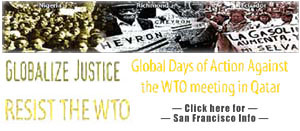
For us in the global justice movement that saw its US expression reach a new stage in Seattle, the fourth ministerial meeting, owing to its location in the Persian Gulf, was never a high priority for an outright large-scale mobilization. Much of the work of getting the voices of the poor countries, labor, and environmental concerns heard at these talks has been carried forth through lobbying campaigns and NGO pressure on the delegates. However, those solidarity actions that were planned for November have been interrupted and setback by the events of Sept. 11. Furthermore, free trade advocates have seized the political space opened by the Sept. 11 tragedy to opportunistically push their pro-corporate agenda.
As such, BGAN organized a press conference for Thursday November 8. The press conference rallied the voices of civil society in expressing concern about the WTO and its implications for labor, the environment, human rights, public health, access to AIDS medicines, agriculture and food safety, national and local sovereignty, and public services. This panoply of issues covering the breadth of human interests, stands to be decisively affected by current and future trade policies under the WTO. By standing together at this critical juncture, we demonstrated that we remain united for fair and democratic trade that serves the public interest abroad and here at home.
For more information on the press conference, click here.
Thank You and Good Luck!
Last Updated: 11.09.01
 Common Front on the WTO (Canada)
- http://www.wtoaction.org
- Global Unions Day of Action
- http://www.global-unions.org/wto-action/
- Mobilization for Global Justice
- http://www.globalizethis.org
- People's Global Action
- http://www.agp.org
- Public Citizen
- http://www.publiccitizen.org/trade/wto/index.cfm
- Trade Justice Movement (UK)
- http://www.tradejusticemovement.org.uk
- USA Strategy Summit (NYC)
- http://www.nowto.org
- Overview
Maude Barlow's Overview on 4th Ministerial
 - http://www.canadians.org/campaigns/maude-wto.PDF
- Labor
Economic Policy Institute's "Fast Track to Job Losses" Paper
- http://www.epinet.org/briefingpapers/118/bp118.pdf
- Environment
WTO and the Fate of the World's Forests
- http://www.corpwatch.org/issues/wto/featured/2001/vmenotti.html
- Agriculture
Trading Away American Family Farms
- http://www.foodfirst.org/pubs/backgrdrs/2001/f01v7n4.html
- AIDS & Treatment Access
A Matter of Life and Death: The Role of Patents in Access to Medecins
- http://www.msf.org/source/pdf/2001/DOHACOL.PDF
- Developing Countries
Plans for Doha Meeting Show Bias against Poor
- http://www.oxfamamerica.org/doha.html
- Corporate Watch
- http://www.corpwatch.org/trac/feature/wto
- Focus on the Global South
- http://www.focusweb.org
- Food First on Agriculture and Trade
- http://www.foodfirst.org
- Global Exchange
- http://www.globalexchange.org/wto/update.html
- Institute for Agriculture and Trade Policy
- http://www.wtowatch.org
- International Centre for Trade and Sustainable Development
- http://www.ictsd.org/ministerial/index.htm
- International Forum on Globalization
- http://www.ifg.org/wto.html
- "Life and Debt" Documentary
- http://www.lifeanddebt.org
- Third World Network
- http://www.twnside.org.sg
- World Development Movement
- http://www.wdm.org.uk
- WTO Spoof Site
- http://www.gatt.org

- Doha Tourism
- http://www.wtodoha.org
- Canadian Government
- http://www.dfait-maeci.gc.ca/tna-nac/wto-e.asp
- EU & World Trade
- http://europa.eu.int/comm/trade/wto_overview/index_en.htm
- US State Department
- http://usinfo.state.gov/topical/econ/wto/homepage.htm
- WTO
- http://www.wto.org
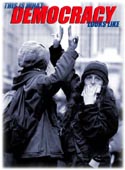 "At the WTO protests in Seattle, we had a collective vision. We saw beyond the borders that divide us. We saw people come together across every kind of political and cultural difference and stand up in a way that we have not seen in this country for decades. We saw peaceful protests shut down one of the most powerful institutions in the world and we saw a system dazed and frightened by the sound of our voices."
-- This is What Democracy Looks Like
- Infoshop's Picture Gallery
- http://www.infoshop.org/octo/wto-pix.html
- "This is What Democracy Looks Like" Documentary
- http://www.thisisdemocracy.org
- The WTO History Project
- http://www.wtohistory.org
- Paul Hawken's Retrospective on N30
- http://www.arcweb.org/campaigns/trade/paul_hawken_retrospective.html
- Police Practices at Seattle
- http://www.aclu-wa.org/ISSUES/police/WTO-Report.html

 THURSDAY NOVEMBER 1, 2001
WASHINGTON DC
Join ACT UP Philadelphia and Health GAP for a march and rally to send a message to the WTO and Bush Administration: Medication Access for All
Event begins at 4:30 pm in NW Washington DC on Thurs Nov 1, location to be announced.
For more info, or to sign the Health Before Wealth global petition to the WTO, go to http://www.globaltreatmentaccess.org
Why Will We March?
Now is a time of re-evalution and reflection on our role in creating a just and safe world. For many of us, the struggle against HIV/AIDS is both a matter of personal survival and a lens through which to view our society's choices that impact people around the world.
The daily reality of unfathomable suffering for millions worldwide from the escalating global AIDS crisis fuels instability and chaos. The fight against HIV/AIDS is the fight for a safer and healthier world. We can not remail silent while our government opposes vital reforms to increase access to lifesaving medication for millions worldwide.
While many of us in the United States have regained or maintained health through access to medication, we can not live in good faith while our tax dollars are used to deny others life. Rather, we will echo the call of our brothers and sisters fighting for their lives: AIDS drugs for Africa, AIDS drugs for the world!
The WTO and Access to Medicine:
The November 9-11 meeting of the WTO will be a showdown between US trade czar Robert Zoellick and 35 million people with HIV.
Many countries of the world- led by a group of African nations-are working to reform the WTO's patent policies. But U.S. Trade Representative Zoellick is siding with drug companies to block reforms and prop up high monopoly prices.
We condemn the efforts of Zoellick to use this time of national tragedy to force through policies that profit drug companies but hurt millions of people with AIDS. And we support legislators refusing to jump on the bandwagon of fast-track legislation in Congress that would give President Bush sweeping authority to sign profit-motivated trade agreements that continue to block access to medicine.
At a monopoly cost of around $15,000/year, drugs have helped people with HIV stay alive in whiter, wealthier nations. This is far too much for poor countries to pay. Without patents, generic competition could bring cost down to less than $350. Piecemeal drug donation or "discount" programs keep power in the hands of the monopoly countries without significantly increasing access to treatment for those in need.
Our government must not act in our names to insist on patent monopolies for poor countries devastated by HIV, nor hand over power to those who have pledged to expand or uphold lethal intellectual property agreements.
Drug companies have nothing to lose from generic competition in poor countries, since almost all of the industry's profits come from just a few rich nations: Africa accounts for only 1.3% of the global drug market.
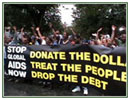
DONATE THE DOLLARS • TREAT THE PEOPLE • DROP THE DEBT
If you are interested in an educational event in your community in the Mid-Atlantic or Northeast Region on global AIDS treatment issues, please contact Julie Davids of the Health GAP Coalition via [email protected]