

As of July 29, 2002
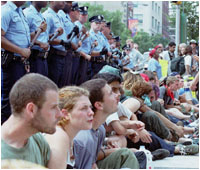 The demonstrations at the Republican National Convention in early August resulted in the arrest of over 420 activists on charges ranging from misdemeanors to full blown felonies. Most of these charges, and especially the exorbitant bails set for the arrestees, have been so completely out of proportion with the civil disobedience practiced by the activists, that the charges can only be interpreted as a strike at civil liberties and an attempt to criminalize social protest in an era of heightened social consciousness.
Members of the R2K Task Force of BGAN who organized buses down to Philadelphia and the Boston Philly Defense Group, a group of supporters and affinity groups who participated in the demonstrations, have come together to raise funds for the enormous legal expenses incurred by the court cases (see October 27 event!). The solidarity work will also include providing other means of support to the persecuted activists, as well as raising awareness of the stakes involved in this attempted repression of political freedoms and civil liberties.

R2K Legal Defense
The Case of Camilo Viveiros
Friends of Camilo
Report: R2K Is Not Over (Oct-4, 2000)
Defend the RNC 420 Fact Sheet
Philadelphia Independent Media Center
WBUR Coverage of August 8 Press Conference
R2K Summary of August 8 Press Conference
Commentary: Don't Let Them Criminalize Protests -- posted by friends of Camille Viveiros, A Boston-based activist
Article: Why We Fight -- Meaning of August 1st Direct Actions
Fact Sheet/Brochure About the RNC Defendants
By R2K Legal Collective
Defend the RNC 420!
The week of August 1, 2000, during the Republican Convention, activists took to the streets of Center City Philadelphia to draw attention to the criminal injustice system. Over 400 protesters were arrested and are still facing charges in Philadelphia court.
- Prior to the actions, police surveilled activists' houses and meetings, infiltrated activist groups, and interrogated people about their plans for the Convention.
- Acting on information obtained through illegal infiltration, police targeted specific activists for pre-emptive arrests.
- On August 1, police surrounded a puppet-making warehouse and arrested everyone inside, altogether over 70 activists who had been making signs and puppets for the demonstrations. When you hear the media saying "We don't know what their message was," that's because the visuals that would have communicated the message were confiscated and later destroyed by the police.
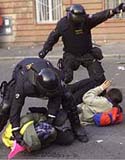
- During the actions, police didn't just arrest people engaging in civil disobedience. They also arrested and harassed bystanders, legal observers, medics, and people who looked like activists.
- Protesters faced what may be the highest bails in history for misdemeanor charges. In one case, an activist's bail was set at $1 million for misdemeanors. While this is an extreme example, most protesters' bails ranged from $10,000 to $250,000, still outstandingly high amounts for misdemeanor charges.
- Protesters also face multiple charges. Instead of the customary citation for blocking a highway, protesters are facing as many as nine charges apiece, including conspiracy charges. Many charges are obviously false, for example, people arrested in the puppet warehouse are charged with obstructing a highway.
- Several dozen protesters were singled out for felony charges, many for felony assault on police. Such charges can bring decades-long jail sentences. The vast majority of these charges, if not all of them, are trumped-up efforts by police to cover up their own violent acts towards protesters.
Taken singly or together, the city's actions deliver a chilling message: Anyone expressing political dissent in Philadelphia will be harshly punished. This is an unacceptable message for a city known as the birthplace of liberty, or anyplace else.
Activists who set out to protest the criminal justice system experienced first-hand some of the routine cruelty and unaccountability of that system.
- Arrested protesters were denied food, water, and urgent medical needs.
- They were dragged, kicked, punched, and handcuffed so tightly as to cut off circulation.
- Some people were held for over 100 hours without being arraigned.
- People who wished to give their names and cite out were not allowed to do so.
If this is the kind of treatment accorded to a unified group of prisoners with media attention and strong support systems on the outside, we shudder to think what treatment awaits an average prisoner in the Philadelphia jails.
Why were they protesting?
The Criminal Injustice System: Some Basic Facts
- Nearly two million people are incarcerated in the USA. That's more than any other industrialized nation, and a quarter of the entire planet's prison population.
- In 1994, one in three black men between the ages of 20-29 were in prison, jail, on probation or on parole. In 1995, 47% of state and federal inmates were black, the largest group behind bars. Black men were 7 times more likely than white men to be in prison. In 1993, whites made up 74% of the general population, but only 36% of federal and state prison inmates.
- The system is more focused on profit than rehabilitation. Private prisons turn a profit by keeping people locked up. Prison labor undercuts good jobs on the outside by paying prisoners as low as 30 cents an hour.
- The War on Drugs is putting thousands of people away to do hard time for non-violent offenses.
- In 1970 there were 5,600 women in federal and state prisons. There are currently 90,000. 60% of that population are black and Latina. The majority are poor women convicted of nonviolent economic crimes such as credit card fraud. The majority of women in prison for violent crimes were defending themselves against abusive husbands or boyfriends.
WE NEED YOUR HELP!
Let Mayor Street and District Attorney Abraham know that you're outraged at t his travesty of justice! Demand that all charges against protesters be dropped.
Contact Mayor Street and D.A. Abraham:
Mayor John Street
City Hall
Philadelphia, PA
(215) 686-2181
District Attorney Lynne Abraham
1421 Arch Street
Philadelphia, PA
(215) 686-8701
Help us pay legal costs! Please donate to the legal defense fund:
PDAG (please make checks out to ISMCH)
P.O. Box 40683
Philadelphia, PA 19107
We're facing hundreds of thousands of dollars in legal costs. Any amount will help.
Donate your time and energy!
Call the R2K Legal Collective at (215)925-6791 and let us know what you can do, or check out our website at www.R2Kphilly.org for more info.
© 2000
Boston Global Action Network
webmaster