

|
Bringing the "Spirit of Seattle" to Boston
In just eight months since its founding, the Boston Global Action Network has helped organize major protests, mobilized for national demonstrations, and started pulling together different sectors of the movement against corporate globalization. It has done so with minimal resources, building upon the local momentum and alliances generated by the anti-WTO protests and the new movement for global economic justice.
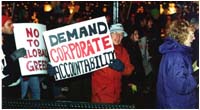
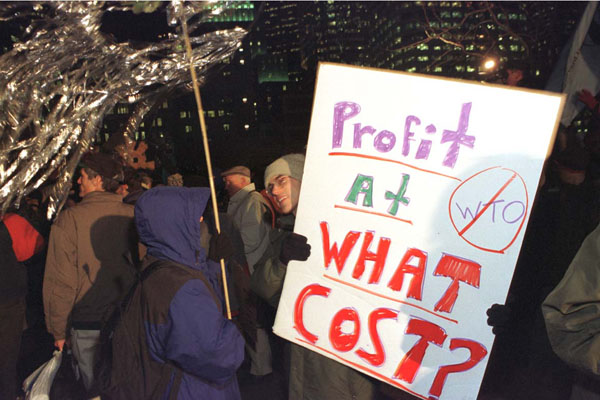
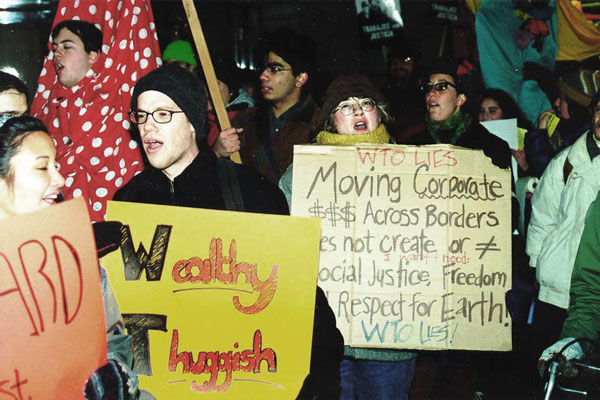
December 1, 1999 was a bitter cold day in Boston. An expected blizzard didn't arrive, but the wind was harsh, and the people who were organizing a Seattle support demonstration that evening were wondering about turnout. They didn't have to worry. Five hundred people showed up, listened to speakers for an hour, and didn't want to go home. "This is the best demonstration I've been to in years!" was a common comment.
BGAN was initiated to capture that energy and give it an ongoing channel. It was deliberately constructed to survive with no staff or office -- and a minimum of political discussion. Its founders, especially Massachusetts Jobs with Justice and United for a Fair Economy, wanted a simple structure that would not get bogged down in political arguments. They chose one that would:
Here is how it was supposed to work. Rainforest Action Network was trying to stop Occidental Petroleum from drilling on indigenous land in Colombia. In February, RAN would organize a protest at Fidelity Investments, a major Occidental stockholder. The other groups in BGAN would turn out for RAN and make it a major protest against corporate globalization. The next month, the biotechnology industry was holding a national convention in Boston. Food safety and environmental groups would organize a conference and protest, "Biodevastation 2000," and BGAN's member groups would turn out for that.
Meanwhile, BGAN shepherded new initiatives that tackled both global and local justice issues. Under it's umbrella, activists came together to organize mass mobilization campaigns for the A16, J30, and S26 days of actions. The first two - A16 tackling the World Bank and IMF spring meeting, and J30 the Republican National Convention, involved enormous logistical work to bus activists to Washington DC and Philadelphia respectively. S26 which coincided with the IMF and World Bank fall meetings, was a local effort held in solidarity with similar demonstrations in cities across the country. Ongoing Efforts The coming together of young activists and veterans of global solidarity movements, of environmental, labor, and social justice causes, of non-profit organizations and radical affinity groups, represents a new phase in the worldwide struggle for justice. In Boston, BGAN represents but one branch of this global resistance to corporate rule. Our task thus in the coming days is to build the unity of the people's movements and link the various struggles in mutual aid, sharing, and celebration. - Excerpts compiled from "A Network Model for Local Organizing", in the upcoming handbook on activist organizing by Mike Prokosch, globalization coordinator for United for Fair Economy. |
||||||
 © 2000 |
|||||||
 The Story So Far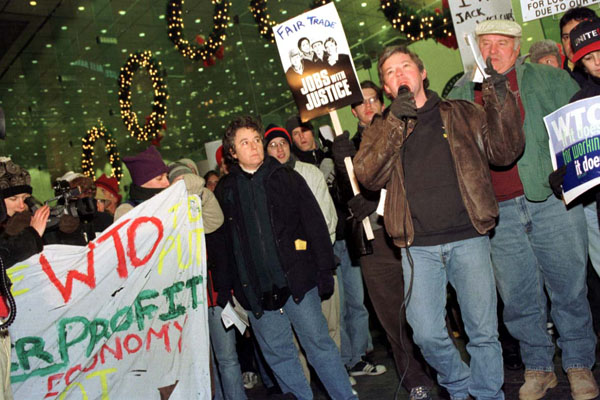
 This actually happened. Labor activists turned out for the initial environmental events. Environmentalists returned the support months later when General Electric