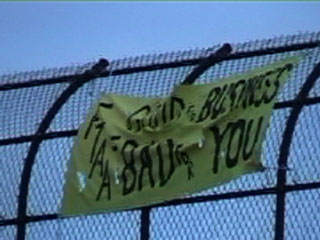
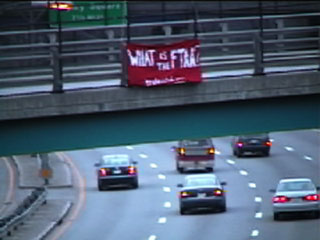
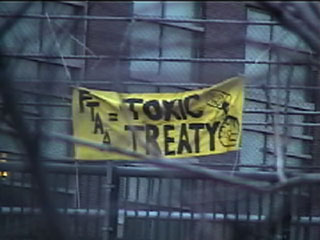
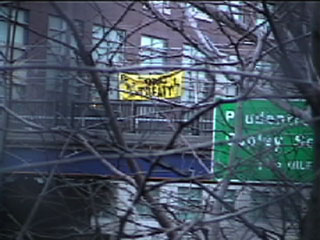
BOSTON – Protestors critical of the Free Trade Area of the Americas (FTAA) dropped banners from bridges crossing the Mass. Turnpike this morning, at 5:50 AM EST. The banner hung from the Carlton Street Bridge confronted in-bound morning traffic with the question "What is the FTAA?". Banners dropped from the St. Marys Street and Brookline Avenue bridges suggested possible responses: "FTAA = Good for Business, Bad for You" and "FTAA = Toxic Treaty". The final banner in the series was hung from the Park Drive Bridge and read "Stop the Race to the Bottom". The protestors claim to be part of an anti-FTAA group known as the Integrate This! Bridge Beautification Committee.
The FTAA is being negotiated as the most far-reaching multilateral trade agreement to date, bringing together 34 nations from the Americas (Cuba is excluded from the deal) in a grandiose attempt to further eliminate tariff and non-tariff barriers to trade. The agreement is to be the principle agenda item at the Summit of the Americas, which is being held in Quebec City between April 20 – 22, 2001. Protests against the FTAA are planned to coincide with this meeting of 34 heads of state.
Negotiated in secret by unelected trade representatives catering to corporate interests, the FTAA will likely extend to the entire hemisphere the constraints on national sovereignty imposed on Mexico, Canada, and the United States by Chapter 11 of the NAFTA (North American Free Trade Agreement). Chapter 11 enables corporations to sue national governments for projected lost profits if their operation is limited by environmental, labor or other national laws or regulation. As such, NAFTA Chapter 11 severely limits the capacity of national governments to defend their own country's environmental and labor regulations and their public interests. The extension of FTAA negotiations to include "services", which included health care, prisons, and education, suggests a likely drive to privatize these services throughout the hemisphere. For these reasons and others, the FTAA represents a shadily negotiated bill of corporate rights which, if signed and implemented between 2003 – 2005 as planned, will promote the flow of capital and facilitate the manoeuvering of big business at the expense of democratic process, of social services, and of environmental and labor regulations.
The banner-drop comes the day after citizens of Boston took to the streets in a festive procession along the "Freedom for Sale Trail" during which they stopped at the local sites of institutions that stand to benefit the most from the signing of such an agreement. Both Boston events were timed to coincide with the "Liberate the Text" events being held Sunday and Monday by citizens' groups in Ottawa in order to denounce the secrecy that enshrouds the negotiations of the FTAA. On Sunday, salAMI, a Montreal-based group hosted a legal demonstration at the Department of Foreign Affairs and International Trade (DFAIT) in Ottawa, in order to pick up the draft text of the FTAA, after the Canadian government refused to release it by the deadline of March 20th. Following the failure of the Canadian government to deliver the text, a blockade that will shut down the Lester B. Pearson building (home of the DFAIT), and a "search and rescue" operation, a citizens' raid to obtain the documents carried out by members of salAMI and allies, are planned to take place in Ottawa today.
Throughout the United States, individuals and citizens' groups have engaged in telephone campaigns to ask their members of congress to put pressure on the U.S. negotiating team to release a draft of the text. Fifty members of the U.S. House of Representatives have written the Bush administration demanding that the text be released, but the American public has yet to see a draft of the FTAA in print.
For more information, please contact Andrea Schmidt: 617.493.7807