

|
|
 |
|
Post 15: April 5, 2000 Post 14: Post 13: Post 12: Post 11: Post 10: Post 9: Post 8: Post 7: Post 6: Post 5: Post 4: Post 3: Post 2: Post 1:
|
 |
|
January 10, 2000: Village Portrait January 10, 2000: January 10, 2000: January 8, 2000: October 20,1999: July 8, 1999: April 5, 1999: March 29, 1999: Feb. 5, 1999: Feb. 5, 1999: Dec. 23, 1998: Oct. 27, 1998: Oct. 13, 1998: Oct. 1, 1998: Sept. 25, 1998: Sept. 17, 1998: Aug. 25, 1998: Aug. 20, 1998: Aug. 11, 1998: Aug. 9, 1998: Aug. 6, 1998: Jul. 31, 1998: Jul. 30, 1998: Jul. 29, 1998: Jul. 26, 1998: Jul. 8, 1998: Jul. 7, 1998:
|
|
|

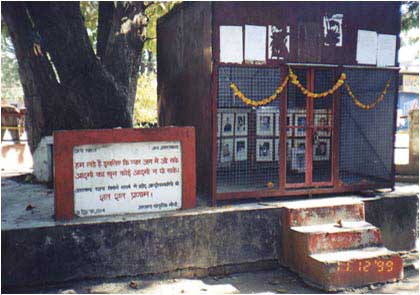
Memorial to the Martyrs of 1994 / R. Rawat
Articles Letters to the Community Our People
All our relations,
Many apologies for the tardiness of this 14th edition of Prayaga. The last few months have been extremely busy, and as noted later in Prayaga, spent partly in India and Uttarakhand proper on a fact-finding tour.
Unfortunately, for many reasons, the end of 1999 did not come soon enough for the beleaguered Uttarakhand Himalayas. Many lives were lost in the Chamoli Earthquake and in Kargil, while the environment suffered heavily from the ravages of forest fires. A great leader was lost, and the long wait for statehood dragged into the fifth year since Prime Minister Deve Gowda announced Uttarakhand's formation in 1996.
It is fitting therefore that we start the new century with fresh perspectives and renewed dedication. The complacent 1990s have ended, calling us to redouble our efforts for the cause of Uttarakhand. Although statehood might not be around the corner and may need to be rethought as an objective worth pursuing -- (i.e., is a crippled state ruled by the same old rascals better than none at all, or are there other options?) -- the noble cause embraces far more than political revolution, but economic, cultural, social, and environmental change.
In this movement, we can all contribute, whether near or far. The internet now reaches out to every part of the world and we can keep abreast of developments back home just as easily as next door. Let us use this global network by joining together and, without further delay, setting ourselves to the task at hand.
All the best in the new year,
R. Rawat
Secretary
R. Rawat
This past November and December, I traveled to my hometown of Dehra Dun after a six year absense. During this trip, I was also able to spend some time in my dadaji's village in the Pauri Garhwal district of Uttarakhand, as well as make quick jaunts to Chamoli and Tehri.
Visiting Dehra Dun with members of the elder generation proved to be an edifying experience. Dehra Dun has changed dramatically since my grandfather settled their 60 years ago. The population has exploded more than ten-fold, rivers have dried up, pollution gone out of control, and commercial and residential development have far outstripped the resources of the valley, leading to severe water shortages. Now, and every year for the last two decades, the fields and trees have disappeared, replaced with dusty, dirty lanes and enough motor vehicle air and noise pollution to cause severe respiratory problems and loss of peace of mind. However, arriving in Dehra Dun from Delhi was a great relief, and the long, circuitous climb from the plains to the Doon Valley was as I had always remembered it -- a return home.
Touring the ancestral village not too far from Satpuli in Pauri Garhwal, was probably the best part of the trip, as a bit of the old Garhwal remained in the hearts of villagers. However, the irony of modernity has been that wherever the road has gone, the culture and values of the people have been subverted (roads have been a major demand in the past and when I was in Dehra Dun, there was a procession taken out to support this goal). Villages that have been spared this development have preserved more of their traditions and self-reliance, while commercialized centres have brought with them the corrupting urban influences and unsanitariness of the plains. This was obvious from the towns visited on the way up to Joshimath, where motor vehicles competed with women collecting stacks of wood heavier than themselves. While village life is hard, trading the peace and spirit of the old hills for the enticing but poisonous fruits of (mal)development, is the devil's choice.
What is most needed is the basics: health care, fuel, fodder, and above all, water. It was made crystal clear that meeting these needs in a sustainable manner is more important than providing Star TV access and the "Total Shopping Network" experience. In important ways, most of us cannot relate to the harsh realities of hill village life -- the daily struggle for survival and the closed world with few educational opportunities. However, it is not too difficult to recognize what can be lost by mindless progress and what little benefit it can provide in place of life's necessities.
As for the Uttarakhand movement, it has all but disappeared, yet the flame still flickers in the hearts and minds of all Uttarakhandis as it has for over 50 years. Since the movement's peak in 1994, the political parties and the professional leadership who seized the statehood platform from the activists, have lost all credibility in the eyes of the people. Indeed, most people I talked to actually feared statehood, as it would mean handing over power to the local elite and politicians who would then proceed to "finish off" the hills, so to speak. Union Territory status as an initial step towards autonomy has gained a measure of support as the region would be centrally administered and infrastructure built. NGO activists voiced similar concerns, demonstrating the irony of Uttarakhandis trusting distant bureaucrats more than their own elected officials.
Although the 1994 political movement was hijacked, the cultural revolution continues never mind the games of politicians. Uttarakhandi Gheet is as popular as ever, and various fairs and festivals celebrating hill culture have been held in the past year. Although many Garhwalis and Kumaonis living in the city have been so alienated from their roots as to see their native hills as an exotic place, others have struggled to preserve their identity and knowledge of their ancestral home. At least, in this, there is hope...
If you have interesting stories to tell of your trips and journeys throughout Uttarakhand, please consider sharing them with the online community. Feel free to email your ideas to me.
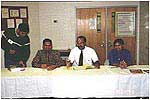
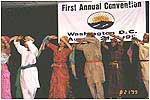
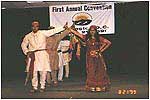
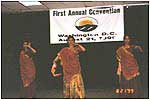
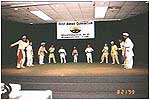
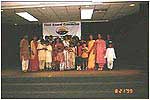
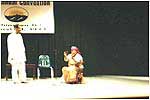
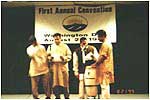
Held August 21, 1999
Washington D.C.
by the Uttaranchal Association of North America
All Photos by:
Vinod Jakhmola
[email protected]
R. Rawat
Looking Back
Indeed, the close of the 20th century parallels that of the 18th century, when perhaps even worse disasters befell Garhwal and Kumaon. Two hundred years ago, Kumaon was occupied by the Gurkhas and the Garhwal court was embroiled in intrigue that would so weaken the raja, that three years later in 1803 after a devastating earthquake, Garhwal would fall to the forces of Amar Singh Thapa. In 1791, Garhwal barely escaped conquest by the Nepali Empire, only to face famine throughout the 1790s. The Gurkhas continued to harry the Garhwalis on the frontiers, even while their military administered Kumaon with severity and brutality. Legends tell of a third of the population being carried off into slavery, although true numbers will never be known.
The Fire this Time
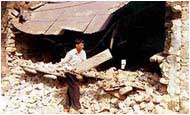 Two hundred years later, an all too familiar apocalypse again visited the hills of Uttarakhand. At half past midnight on March 29th, 1999, the strongest tremors since the 1991 Uttar Kashi earthquake rocked the hills. This time, it was Chamoli district’s turn and thousands of houses collapsed in the pre-dawn hours, trapping sleeping villagers in the debris. The death toll eventually surpassed 100, and the reconstruction effort started slowly. Eventually, charges of bureaucratic neglect and disorganization began to stick, and the issue of disaster preparedness would come back to haunt the central government during the Orissa Cyclone.
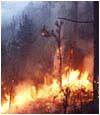 Earlier in 1999, life came to a standstill in villages throughout upper Garhwal, as leopards claimed the lives of a dozen women and children. By April, forest fires had ignited, eventually claiming over 40,000 hectares in forest cover. Although part of a 4 to 5 year cycle, the especially dry winter this past year, coming after devastating monsoon-related landslides in Upper Kumaon and Garhwal and floods in the plains in 1998, helped make a tinderbox of the highly flammable pine needles littering the forest grounds. Several forest workers and villagers died battling the blaze that choked the air with soot particles and smoke for two months. The forest fires also contributed to the wild predator menace, as starvation and habitat destruction pushed leopards to seek food in human areas.
The Wages of War
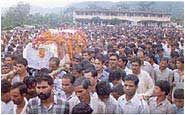 Eventually, these events came to be overshadowed by the war in Kargil that gripped the Indian public’s attention. Over 75 men from Uttarakhand perished in the hostilities and funeral processions were held throughout the hills. Half of these men were lost from the Garhwal Rifles alone, and a battalion of the regiment was awarded a unit citation. Their sacrifice led to a surge of patriotic pride, as the nation pulled together to counter the invasion in the extreme north of the country. Questions that arose early in the undeclared war quickly dissipated, as the nation faced the grim news with renewed dedication to throw out the invaders.
A Hero’s Fall
As the Kargil conflict wound down, Uttarakhand was shocked to lose one of its brightest lights and most respected political figures. Indermani Badoni, a stalwart in the cause of Uttarakhand statehood, passed away in August after a long battle with kidney disease. Five years previously, Badoni fasted onto death while all hell broke loose in the hills during the anti-reservation stir that led directly to the statehood movement. For his efforts, the police attacked the non-violent fasters, beat their supporters, and hauled them to the hospital on the orders of the DM. Since those fateful days, Badoni worked tireless, despite failing health, for the cause of Uttarakhand, and retained his stature as the Gandhi of the movement, despite disillusionment with the proclaimed saviours of the Himalayas. Reportedly, Badoni breathed his last by uttering the word "Uttarakhand".
Politics as Usual?
With his death, the Uttarakhand Kranti Dal, the local party that initiated the movement but lost control and popular support, went through a power struggle. An effort was made to revitalize the moribund condition of the party that had its vision and slogans hijacked by the national political parties for their own partisan ends. Yet the need for a genuine progressive force, representative of local interests alone, and with the ability to unite the entire spectrum of Pahari society, remained. Many felt that whether the UKD could claim this mantle would determine its future as a viable political entity.
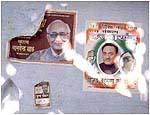 Meanwhile, as the UKD reorganized itself, political intrigue flared as the BJP struggled to retain its seats in Uttarakhand. In the October 1999 elections, Congress mounted an unexpectedly strong challenge even while its Uttar Pradesh party organization lay in shambles. The BJP still managed to retain 3 of its 4 seats, helped in no small measure by the victory in Kargil, Vajpayee’s personal popularity, and lingering divisions and disorganization in Congress. The margins of victory for the three seats were however extremely reduced, and Congress still managed to win the largest overall percentage of votes in the region and wrest back the Nainital seat for veteran party man N.D. Tiwari.
To shore up their falling fortunes, the BJP managed to induct a minister from the region, Bacchi Singh Rawat, into the outer cabinet of the new NDA government. As the first minister from the region since Satpal Maharaj’s stint in the United Front government, the Almora MP was given the minor portfolio of minister of state for defence.
The Movement Refocuses
By December, continued wrangling over the BJP-sponsored Uttaranchal statehood bill had led to the reconstitution of the Uttarakhand Sanyukta Sangarsh Samiti to renew the struggle for statehood. Although the original USSS fragmented in the post-1994 agitation period, the new formation drew in political heavyweights from the region as well as new blood.
Despite these developments, the end of the year saw the sentiments of many urban and rural-based Uttarakhandis swing away from immediate statehood to Union Territory status. This option gained support at the expense of the professional leadership and politicians of the hills who had failed in the eyes of the people and discredited themselves in the process. The apprehension of handing power to the politician-bureaucrat combine led many of the genuine social activists in the region to prefer central administration for the fledgling autonomous entity.
Looking Forward
In this manner, the seeds of renewal and growth were planted in little turning points and realizations in a year so marked with death and despair. The scorched earth left by the forest fires may blossom again in the coming years if villagers and the forest department come together to take remedial action. The earthquake again pointed to the need for preserving traditional building practices, which time and time again have withstood Himalayan tremors. Indermani Badoni’s passing jolted the slumbering movement back to life and reminded politicians of what it meant to work in the service of the people. Likewise, the sacrifices of soldiers in Kargil were finally given their due by a nation that had all too often forgotten its obligations to the fallen. Even in the shift away from the statehood demand, people demonstrated newfound understanding of the political process.
Two centuries ago, British intervention followed Gurkha conquest, bringing the hills into an Indian empire of sorts for the first time and a new social, political, and economic age. In such ways has change always followed sorrow like a shadow in Uttarakhand. However, hope for a better tomorrow will depend on the strength and character of the people to endure both adversity and build anew. With the dawn of the 21st century, it remains to be seen whether that hope becomes reality and sorrow turns to joy.
Photo Credits: Earthquake -- BBC, Forest Fire -- Garhwal Himalayas Page, Kargil Funeral -- Doon City Chronicle, Elections -- Personal.
The Struggle for Cultural Survival:
Reviving and Renewing our Uttarakhandi Identity
R. Rawat
How do we as a people face extinction? Our land, unlike Kashmir, Punjab, or Assam, has not been wracked with violence. We have not suffered terrible cyclones like Orissa, nor bloody riots like the rest of Uttar Pradesh. Bombs have not exploded in crowded marketplaces as in Delhi or Mumbai, Indeed, Uttarakhand has always been one of the most peaceful places in India.
However, the cultural extirpation of our people has continued as inexorably as the encroachment of the desert into the hills. The language, agricultural heritage, and social traditions have been steadily eroded, just as the life-sustaining capacities of the land have been degraded. The money order economy that has accelerated throughout the century has contributed to this decay, but so have the effects of modern development, ostensibly welcomed by the people, but now wreaking havoc on the social mores of village life.
Education for Joblessness
For younger generations, the Indian education system has also been central to the unfolding catastrophe. Indeed, the system has changed little since the British left, and has continued to operate under the same compulsions. Even today, English has remained enshrined as the language of the elite, followed by Hindi as the vernacular and, in some cases, followed by a powerful regional language that thrust its way into the curriculum.
However, very few schools, if any, teach the Pahari languages of Garhwali and Kumaoni, as they have traditionally been devalued as mere rustic dialects and excluded from a child’s education. Intense competition has further eroded the desire to retain such "luxuries", as local self-awareness has usually been the first to lose out. Language, culture, and traditions of workmanship are being replaced with an education that throws youth into direct competition with hundreds of thousands of other students. Furthermore, no longer can the recent generations live off the land. They cannot return to the village nor can they find a job.
As such, the alienated urban youth that is often talked about in lurid news stories, did not appear out of thin air. They are the sad products of this uprooting and confusion, caught between cultures and demands on them they cannot even comprehend, let alone fulfill. Desperate and jobless, the lucky can enlist in the military, the best ironically work at any job no matter how degrading to preserve their dignity, while the worst turn to alcoholism and even crime, filling the ranks of the mafia, spreading their tentacles over the hills. It is a sad story repeated in every urban center in Uttarakhand, from Dehra Dun, to Kotdwar, to Nainital.
Planned Termination?
As either a by-product of negative social change or part of a planned effort to eradicate cultural distinctions for the sake of national integration, the heritage of Uttarakhand and local cultures throughout India have been quietly undermined in this fashion, and completely purged from the spirit of city migrants and expatriates. It is only with great difficulty that any cultural vestige has been retained, and often in only the superficial sense, as in tape recordings of Garhwali Gheet or jewelry that once adorned all women of the hills. For others, shame has prevented even this minimal identification, and anything to do with the hills has been forsaken as rustic and backwards. For all though, the sense of loss has remained palpable.
Indeed, rulers long ago realized that the easiest way to control and subjugate a people is by forcing them on their knees. To do this, they first have to knock their victim’s legs out from underneath them, a feat accomplished by tearing out their roots, crushing their identity, and corrupting their value system. Once done, the conquered individual is rendered a saleable commodity in the political marketplace, mentally and financially enslaved to the system.
The experience of Native Americans has been the most tragic example of this murderous strategy. Long after disease and warfare had ravaged the peoples of the Americas, the final masterstroke of their conquest was the liquidation of their cultural identity. This final solution to the Indian problem was carried forward forcefully, by uprooting tribes from their ancestral lands, destroying their way of life, rendering them dependent and subject to the federal government, and packing off their children to far away religious residential schools for final assimilation. Speaking their language and practicing their religion became both crimes and sins, and a whole generation, if not more, were ethnically cleansed in this way.
For Native Americans, the loss was traumatizing and lethal. Countless languages and traditions were simply annihilated, leaving the survivors with only fragmentary images of their own culture. In many cases, these images were ironically derived from stereotypes of them held by European Americans.
Tribes in India and marginal peoples like Uttarakhandis have likewise felt the pressure to assimilate while retaining romanticized visions of hill life to buttress their fragile identity. Furthermore, for many of those having found prosperity elsewhere in Dehra Dun or Delhi, the forces of false pride and vanity have rushed into the vacuum, a development as dangerous as the emptiness of rootlessness. In the special case of upper class Garhwalis and Kumaonis, their caste status, a known quantity in general Indian society, has gained them added currency, and in the place of nothing else, has propped up a tottering self-image (ironically, higher caste status has become more of a liability in the post-Mandal period). Eventually though, such artificial and reactive attempts to reconstitute shattered self-esteem have ultimately floundered when passed down from one generation to the next, as young people have seen no reason to retain the prejudices, conservative outlook, and muddled identity of their elders. In this manner, the inferiority complex has persisted, and countless youth cut off from their last remaining ties to the hills. Moreover, the urban culture, with all its venality, duplicity, and inhumanity, has had its impact, subverting the spirit in more alarming ways than even loss of culture has rendered.
In the village, excessive drinking has taken an even heavier toll, further sapping the energy, draining the potential, and wasting the precious monetary resources of the hills. In the case of Native Americans, the story of alcohol abuse has been tragic and largely fueled by those wishing their destruction as a people. It is thus no coincidence that home breweries are few in the Uttarakhand Himalayas, and villagers depend on outsiders such as mafia from Ghaziabad, Etah, or Moradabad for a steady supply of "daru". Furthermore, the liquor plague has led to resignation in face of hardship and the destruction of family life. Women, who have always borne the lion share of work in Uttarakhand, have suffered even more sorrows from husbands who have wasted their hard earned wages on alcohol either in the village, or away, lost in the cities of the plains.
A Wake-Up Call
What can we do then? How can we fight these seemingly invincible tides of urbanization, cultural disintegration, and assimilation? How can we reestablish a cultural identity that is no longer defensive and conservative, but progressive and thriving, and that has resonance with today’s youth?
In the experiences of other peoples, we can find ways out of the current predicament. Just as Martin Luther King, as a follower of Gandhiji, led the civil rights movement in this country with all the methods of a true satyagrahi, so can we learn from another great black leader, Malcolm X, who awakened the black consciousness and fired the imagination of revolutionaries worldwide. Through his own experience as a small time hustler, drug user, and prison inmate to his remarkable rise in the Nation of Islam, Malcolm X made the most personal journey from self-hatred to self-love, from utter humiliation to racial pride. He overcame the worst form of degradation to inspire others with his intense and unrelenting intellect and moral uprightness. He came to embody the "shining black prince", a legendary figure who opened the door to the rising of the entire race. His doctrine of dignity and self-worth was to prove central to the struggles of other minorities in the United States, including Native Americans whose resurrection as a people was helped in no small measure by the rising of black America.
In this way, we do not have to wait for saviours to come and rescue our race. We cannot depend on politicians or bureaucrats to show us the way -- indeed, we need to get rid of them for our people to progress! We each can contribute to the reawakening of our people, individually and together, by preserving the best of our traditions -- social, agricultural, environmental, and cultural -- and learning about our homeland -- its language, history, geography, and economy. Succeeding generations need us desperately to articulate an inspiring vision for our people, one that brings us forward into the next century with raised heads, renewed hope, and a revived sense of who we are and what we stand for. Most of all, this revolution of values and spirit will need us to remain large hearted as only then can our pride in ourselves grow as a healthy pride, one born of the holy Himalayas and steeped in the patriotism of a gentle and courageous, honest and loving race.
An Appeal to the Uttarakhandi Diaspora
Manohar Shyam Joshi
[email protected]
November, 1999
Dear Friends,
A recent visit to the super-rich U.S.A. followed by a trip to the utterly poor villages of Uttarakhand made me realize that the small change which a U.S. citizen treats as almost worthless would, when translated into Indian Currency, mean a lot to the poor and needy of Uttarakhand. So please don't throw it around. Collect and donate it for the poor back home. If available, also please use facilities for exchanging recycleable items for 5 cents each and keep that amount aside for your poor Uttarakhandi brethrens. You can also donate your old clothes and shoes etc to them.
You can either directly help some people or you can route your donations through some known organizations. I came across people who run three such institutions and I recommend them to you.
1.
Mr. Ganesh Chandra Pande, ex-director Shri Ram Research Institute, Delhi has donated his entire savings and property to help the poor and needy of Almora District. His organization would accept donations in cash as well as kind. It distributes sustenance allowances, scholarship, books, clothes & shoes etc. His address:
Mr. G.C.Pande
The Vishnu-Heera-Umesh-Pooran Public Charitable Trust,
Mohalla Dubkiya
Almora 263601
Uttar Pradesh
2.
Mr. Lalit Pande, who has a doctorate in Environmental Engineering from a top U.S. school, runs the Uttarakhand Environmental Education Centre, which arranges training facilities and funds for Uttarakhandis dedicated to the development of their village. He accepts cash donations only. His address:
Mr. Lalit Pande
Uttarakhand Environmental Education Centre
Jakhandevi, Almora 263601
Uttar Pradesh
email : [email protected]
3.
Mr. Pawan Gupta, an IIT'ian and his wife Anuradha (Meenu) run the "Society for the Integrated Development of Himalayas" which has done excellent work in the tribal belt of Garhwal. The organization accepts donations in cash as well as kind. The address is:
Mr. Pawan Gupta
Hazelwood Cottage
PO Box 19
Landour Cantt., Mussoorie 248179
Uttar Pradesh
If and when I get more addresses I will pass them on to you. Meanwhile, I do hope that this appeal would help generate a big effort by the Uttarakhandi Diaspora to help the poor and needy back home. Please spread this appeal around.
-- Manohar Shyam Joshi
These contacts have been added to the master voluntary organization list with additional information on other NGOs.
R. Rawat
As you may have noticed, the front page of the www.uttarakhand.org site has been redesigned to reflect ongoing renovations to the entire site. The familiar red and orange burn on black has been transformed into gentle green and pacific brown on white. All the news archives have been reformatted and sequenced properly, a laborious task that took many weeks. Also added are several more links to other projects and resources on the internet, such as revealing feature articles from various online sources, the Western UP Telecom Exchange which features online searchable telephone directories, the UP Tourism Board's web page, and links to the Canadian and US Uttarakhand/Uttaranchal organizations.
The main additions are:
1.
The Hall of Martyrs
www.uttarakhand.org/memorial.html
This page commemorates those who died in the Uttarakhand State Movement, and includes pictures of the memorial at the Dehra Dun Court.
2.
Uttarakhand Pyaru: The Village and its People
www.uttarakhand.org/exhibit/p-begin.html
This is a slide show, about 37 pictures in all, of one village in Pauri Garhwal. Included is commentary about village life.
3.
Uttarakhand Pyaru: Other Scenes from Garhwal
www.uttarakhand.org/exhibit/s-begin.html
This slide show includes pictures of places in and around Dehra Dun, as well as places alongside the Alaknanda River.
4.
List of Voluntary Organisations
www.uttarakhand.org/ngo-list.html
This list, far from complete, will hopefully prove useful to anyone wishing to work in the region on social and environmental issues. There are many NGOs active in Uttarakhand, and this page represents but a small sampling. I await comments on members of the organisations for further information and edits to the texts presented here.
5.
Sketch Map of Dehra Dun
www.uttarakhand.org/maps.html
This map was sketched from the 1:20,000 Survey of India map last published for the city in 1982! In the last 18 years, things have really changed, especially with the incredible sprawl of the town and new housing developments. However, it does show major areas of Dehra Dun where many voluntary organizations have their offices.
Paths of Dialogue:
Announcing the Uttarakhand Discussion Group
Uttarakhand Support Network eGroup
www.egroups.com/group/uttarakhand/
Since its inception, the Uttarakhand Web Site has strived to bring Uttarakhandis and people of Uttarakhandi descent together in common cause. This cause, the welfare of Uttarakhand as a whole, is as vast as the problems that face the hills, its inhabitants, and even its expatriates. Social, environmental, cultural, political, and economic issues have all become major concerns in mountain societies and are all in need of solutions. Although hundreds of groups and governmental agencies have been active in addressing each one of these, none has been able to deal with the complex brew in its totality. The geographic diversity of Uttarakhand has also hampered attempts to broaden the reach of NGO-initiated projects. As such, the web site was envisioned as a way to highlight all these struggles, document and network their noble efforts, so that activists and laypeople alike could draw inspiration from their fellows in the field and rally to their aid.
The creation of an Uttarakhand electronic discussion group is one of the latest tools deployed to further this cause. Active for an initial trial period of 2 1/2 months, the Uttarakhand Support Network eGroup has been open to a select number of participants who originally voiced interest in doing something substantive for the Uttarakhand Himalayas. So far, much of the discussion has focused on establishing the means necessary to lend monetary and organizational support to social, environmental, and economic uplift efforts back home. Although no concrete organization has yet been established, the group is fast approaching the point of laying down the structures and mechanisms to achieve their aims.
With this progress and the near completion of the list of voluntary organizations, I would like to, on behalf of the eGroup, invite the participation of all those interested in working for the welfare of Uttarakhand.
To subscribe please send a message to: [email protected]
To post a message to the group, send a message to: [email protected]
Once subscribed, the mail recipient is registered as a user of the eGroup and can thus modify account settings to suit their needs (i.e., digest mode for daily updates or read-only on the web).
The web address of the list is: www.egroups.com/group/uttarakhand/
The ground rules for participation in the eGroup are listed as follows:
A. Purpose of The List
The Uttarakhand Support Network is an electronic forum for discussing issues pertaining to the social, cultural, environmental, economic, and political well-being of the Uttarakhand Himalayas. As such, it hopes to function as a non-partisan, un-affiliated, and independent clearinghouse of ideas, and staging ground for efforts directed at ameliorating the quality of life, economic soundness, environmental sustainability, and cultural survival of the hills.
B. Messaging Procedures
- Papers and articles are welcome, yet cannot endorse political candidates or political ideologies. All usage of the list should respect the tenets of non-partisanship, impartiality, and independent thought and cannot be abused for partisan political ends.
- All discussion-related emails should be MORE THAN one line but less than three paragraphs long. This should keep the discussions focused and interesting to all recipients.
- When responding to a mailing, DO NOT simply reply. Instead send a new message to [email protected]. In the Subject Heading, simply tag " - reply to _____" at the end so that recipients know the context of the new message. This should cut down on excessive quoting of email that lengthens their size over and beyond what is necessary.
- If worried about the traffic on the mailing list, feel free to contact the list manager, or set up a new folder and filter in your mail application for just this mailing list.
C. Respect and Goodwill on the List
Cultural differences can exhibit themselves in potentially destructive ways on mailing lists. The difference between American and Indian forms of addressing and discussing have always been troublesome as the often abrasive and vituperative style of Indian debating can offend an American ear more use to soothing words of support and vagueness. Sensitivity and compassion are thus better suited to this arena than intense debates and fierce emails. Happy faces are recommended, or else! :)
Keeping the above in mind, we must strive to understand and care for one another to the best of our ability. We all have our strengths and weaknesses, and this forum should work to draw on those strengths and to dispel the weaknesses. After all, division has been our main stumbling block as a people for nearly a century, and to exacerbate them once more would cause greater harm in the process.
However this does not mean we should remain apolitical, agnostic, or apathetic. We all have different experiences, backgrounds, and maturity levels that impact how and what we'll say over email. We may understand the world in fundamentally different ways than other people, but this should not prevent us from rallying together and making common cause.
As such, we call on all to exercise good judgement during the course of this new endeavor. Hopefully, it will prove useful and instructive, as well as lead to substantive movement towards concrete results.
For more information, please contact:
Somit Joshi or Rajiv Rawat
Land of the Gods and the Brave:
An Uttarakhand Profile
Air Marshal Brijesh D. Jayal ( Retd)
[email protected]
Originally submitted January 5, 2000 to the Hindustan Times
The upsurge of nationalist feeling that cemented the nation during the Kargil crisis has long blown over. While the nation marches on, for the families of the servicemen killed and those maimed, life will never be the same again. Before the nation forgets, it is appropriate to awaken national conscience to one remote corner of the country whose brave inhabitants have paid a heavy price in every conflict involving the armed forces of this country, Kargil being only the latest. This is the Uttarakhand region of Uttar Pradesh nestled within the Himalayas - the abode of the Gods.
To most Indians it means another of those regions agitating for statehood and whose name features only fleetingly at election times when promises are made only to be forgotten. But it is from here that no less than 64 out of the 430 plus servicemen gave their lives in the Kargil conflict, a whopping 15% of the total lives lost! Compare this to the population of this region, which is a mere 60 lakhs or 0.6% of the national total.
Situated within Northwest UP, the region is flanked by Himachal Pradesh, Tibet, Nepal and the plains of Uttar Pradesh. Culturally and politically the region is divided into Garhwal and Kumaon. Garhwal comprises six districts of Uttarkashi, Chamoli, Dehra Dun, Pauri Garhwal, Tehri Garhwal and Rudraprayag. Kumaon also comprises of six districts of Pithoragarh, Almora, Nainital, Bageshwar, Champavat and Udham Singh Nagar. The river systems of this region are the Yamuna, Bhagirati, Alaknanda, Ganga, Ramganga and Kali. The places of pilgrimage include Badrinath (Vishnu), Kedarnath (Shiva), Gangotri, Yamnotri, Hemkund (Sikh), Surkanda Devi Temple (Durga-Shakti), Hardwar, and Rishikesh.
While most Indians know of Uttarakhand’s river systems, mountain peaks, glaciers and places of pilgrimage, they know little and care even less for the people of this region, their economic backwardness, aspirations and contribution to national security. Contrary to perception, Uttarakhandis are not only hill folk, but all those from various parts of this diverse country, and some from abroad, who have made this region their home. That is one reason why emotions have run high on attempts to cut out Udham Singh Nagar merely on the basis of its lower density of hill population -- notwithstanding that this itself is the historical consequence of unfulfilled and broken promises to ex-soldiers of the hill region who were to be resettled here.
It needs recalling that the demand for a separate hill state is not something recent. Prior to independence, intellectuals had expressed the view that for meaningful development to be possible, a separate hill state was a pre-requisite. The proposal was also presented to the States Reorganization Commission in 1956.The population of this region is a mere 4.3% of the total of the state of UP. Because the area is mountainous and its social and economic problems somewhat different to the plains of UP, its developmental needs and priorities have never been appreciated, leave alone addressed. 70% of the region’s population lives below the poverty line against a national average of 46%. 60% of the families have at least one member earning his or her livelihood away from the region. In many cases, womenfolk tend to the land and family while the male members are away earning their livelihood leading to coining of the phrase of a ‘money order economy’.
Security wise, the region’s northern border is lived with troops facing the Chinese. Of the population, over 8% or 5 lakh consist of ex-servicemen. In addition, the region provides two major regiments of the army, namely the Garhwal and Kumaon Regiments. Many from this region serve in the Kumaon and Garhwal Scouts, Naga Regiment, Assam Rifles, Bengal Engineers and various arms of the three services. Rolls of Honour in regiments, squadrons, and ships bear testimony to brave sons of this soil who for generations have sacrificed their all for India’s tomorrow.
Indeed it is a fair assumption that no other region or state of this country has a greater percentage of its population directly dependent on serving and retired armed force personnel. Of this heritage the Uttarakhandis are proud. One has to meet with ex- servicemen and their families in some of the remotest regions to get a feel for their sense of loyalty to the security and integrity of the country, notwithstanding their extremely deprived and spartan existence.
It was this spirit that was given a jolt in 1994 during the heart of the Uttarakhand agitation when brutal handling of peaceful agitationalists took place. Incidents at Mussoorie and Khatima, when unarmed protesters were shot and later at Muzzafarnagar when protesters proceeding to Delhi were brutally beaten, killed and women raped, will never be forgotten. Already folk ballads are testimony to this black chapter. To Uttarakhandis, this was ungratefulness personified. To the ex-servicemen amongst them, it was izzat defiled. To add insult to injury, the Chief Minister of the time, later donned the mantle of Defence Minister. Such is the insensitivity of our polity to the sentiments of the region and its large serving and retired service population. Mercifully, Uttarakhandis are made of sterner stuff.
True to the best traditions of the armed forces, the ex-servicemen of Uttarakhand recognized that the ground was fertile for anti-national elements to step in, as has happened in many other parts of the country. To fill this void created by political ineptitude the ex-servicemen started a non-political association aimed at harnessing the energies of their erstwhile colleagues towards nation building rather than nation destroying. Thus not only were wounded emotions smothered but political and anti-social opportunists isolated. The other day, at the first annual general meeting of this association after the Kargil conflict, as these mufti-clad ex-generals and jawans stood shoulder to shoulder in silence to mourn their dead, one could see determined sorrow on their faces. Sorrow borne out of hundreds of "Last Posts" sounded for such fallen heroes. And determined, as even in retirement call of duty to national integrity and solidarity had to be answered with honour and dignity. Their greatest achievement, unknown to our myopic polity, has been to ward off potential insurgency in the face of severe deprivation and provocation.
Today as pilgrims by the lakhs visit the holy shrines of the region and many more millions worship and live by the holy rivers that begin their journey from these rich mountain glaciers, as thousands of brave sons of the region stand vigil on the borders, and as the people learn to live with the sacrifices that their brave sons continue to make; inhabitants of the region wait for the nation to repay its debt to enable them to lead a better life. Reared in the true spirit of nationalism they will not let their region tread the slippery slopes of anti nationalism. Sometimes, as nearly happened in 1994, their patience appeared to wear thin! But for the inhabitants of Dev Bhoomi-Veer Bhoomi, nationalism has and will always prevail.