

| Uttarakhand resembles other parts of the Himalayas where various ethnic groups live side by side. Following chiefly the agrarian-pastoral way of life, native Uttarakhandis make their living from the hilly land the best they can. Some, like the Bhotia traders, migrate far and wide, although the ancient trade routes with Tibet have been closed since 1950. Great fairs that bring all the peoples together are held throughout both Garhwal and Kumaon, the two geographic and linguistic divisions of Uttarakhand. Most of the indigenous people are heterodox Hindus and Buddhists, while Sikh migrants from West Punjab have settled in the lowlands since 1947. A few Muslim groups are also native to the area, although most have come recently. The Muslim Gujjar herders also migrate to the hills. |
 |
 |
 |
 |
 |
||
|
|
|
|
|
|
|
|
Caste Stratification of Garhwalis and Kumaonis
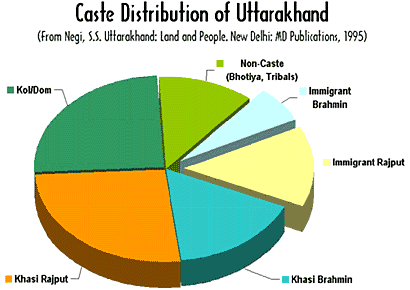
Garhwali and Kumaoni Rajputs are generally the main cultivators of Uttarakhand, although Brahmins may also farm. Kols or Doms, (collective name for indigenous low-caste groups) generally have little or no land and engage in little agricultural activity, while the artisan castes create traditional implements that farmers use. Most villages are dominated by Rajput cultivator families (45-60% of population) with artisan and low caste groups providing a diverse array of services to the entire community (e.g., barber, blacksmith, carpenter-mason, weaver, drummer - "Bajgi" or "Auji" - also engage in shamanism, singing, tailoring, and basketmaking). Unlike the plains, the Rajput (Thakur and Khasi) farmers do no usually employ sharecroppers or tenant farmers as their lands are small and cultivated by single families. As such, the problems of landlordism have not arisen to the extent it has a short stone throw away in the Terai.
There is no indigenous trader class, which also sets Uttarakhand culture apart from those of the plain. However, all Uttarakhand castes and especially the Bhotiyas migrants (Tibetan-speaking Buddhists) may engage in commerce.
 |
|
|
|
|
(Just beyond border with Tibet and Nepal) |
(Hoon, 1996) |
The Bukshas are inhabitants of the Terai, although their locality falls in the Western fringes of Nainital (now Udham Singh Nagar) and borders that of the Tharus. Although they claim descent from Rajputs (like the Tharus they are of Tibetan descent), the Bukshas have merged all their castes and even today, observe only septs (family names) among their people. Bukshas still worship Hindu gods, though also accept the existence of spirits and eat meat. In addition, a Seyana (literally, "Wise One") also administers to their medical/spirit needs.
Bukshas build their houses in two rows, with the space in between serving as a courtyard. As shifting cultivators, the Bukshas made the best of the protection afforded them by the inhospitable and malarial marshes of the Terai. However, since the coming of migrants from other states throughout the 1950s and 1960s, the Bukshas have lost much of their land. Many have ended up as labourers for the new masters who gained their land through foul and unlawful means.
The Tharus are a tribal Tibetan-related people that originally inhabited the eastern zone of the Terai, along the border with Nepal. They are subdivided into many sub-tribes, although a majority of them live in Nainital (now Udham Singh Nagar). As agriculuralists, Tharus tend to have large families that live communally, and it is traditional for brothers to live under one roof. Tharus observe ancient beliefs and like others in the hills, subscribe to shamanism, but also worship Hindu gods. Tharu women, in claiming they descend from Rajput Ranis of Chittor, enjoy a high position in their society, as they tend to play a dominant role in family affairs.
The Rajis, also know as Vanrawats (forest lords) are few in number and live in the forest. They inhabit the woods around Ascot in southern Pithoragarh (now Champawat district), and hold to a tradition of saluting no one except the Ascot Raja. They once practiced shifting cultivation until it was banned by the forest department. Although their agriculture was never well developed, they subsisted on the products of the forests, from edible roots to fruits to the crafting of wooden utensils to trade for other commodities.
The Raji religion also reflects their unique world view, that keeps them aloof from most others around them. For their own gods and some adopted Hindu ones, the Raji construct simple open-air altars with prayer flags and cloth swaying in nearby trees. Their marriage rites are also simple, without Brahmin or priest.
With the acceleration of development and communication with the outside world, the Raji have struggled to maintain a way of life they greatly value. Onerous forest laws have also made life difficult.
Unfortunately, this is only an incomplete ethnologic survey of some of the peoples of Uttarakhand. The following books should shed more light on the subject:
-
A Bunch of Wild Flowers and Other Articles / A. Hasan. Lucknow : Ethnographic and Folk Culture Society, U.P., 1971.
Saili, G. "The Flower Children of Garhwal." Probe India September 1993: 3-5.
Hindus of the Himalayas / G. Berreman. Berkeley: University of California Press, 1963.
Living on the move : Bhotiyas of the Kumaon Himalaya / V. Hoon. Walnut Creek, CA : Sage Pub., 1996.
Kumaun Himalayas: A geographic perspective on resource development / S.C. Joshi, D.R. Joshi, D.R. and D.D. Dani. Naini Tal : Gyanodaya Prakashan, 1983.
Uttarakhand : land and people / S.S. Negi. New Delhi : MD Pub., 1995.
Harijans of Himalaya : with special reference to the Harijans of Kumaun Hills / H.C. Upadhyay. Nainital : Gyanodaya Prakashan, 1990.

Return to Home Page