
A full summary of the story will appear soon!
| The epic ballad, Rajula and Malushahi, has been sung in the Kumaon Himalayas for at least a thousand years. Set at the time when the Katyuri dynasty was fragmenting into independent fiefdoms, the ballad traces its origins to around the 10th century A.D., when a king no longer reigned from the capital of Kartikeyapur. Instead, the ballad tells the tale of one successor king, Malushahi, who ruled from Bairath, near present-day Dwarahat. The king, although already married to seven queens, falls in love with Rajula, the beautiful and intelligent daughter of Sunapati Shauka, a Bhotiya trader of Tibetan goods. Their romantic adventures in search of one another take them to the far corners of the Himalayas, where intrigue, treachery, violence, black magic, and even death conspire to keep them apart. |
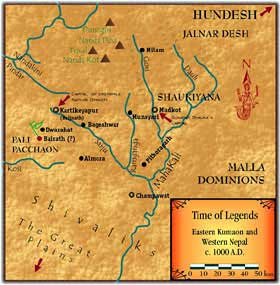 Map of the Medieval Trans- Himalayas where the Ballad takes place. Click on it to see the larger map.
|
| Furthermore, Rajula and Malushahi is one the most comprehensive ballads of Kumaon. In their travels, the principle characters visit many places and deal with at least three distinct cultures - the Katyuri, Bhotia (Shauka), and Tibetan (Huniya). Unlike other tales, the characters never become gods, nor are overpowered by them, as Malushahi and especially Rajula use their wits to escape danger time and time again.
|
 What Rajula may have looked like. |

The Balladeering Tradition
As much of the lore of the Uttarakhand Himalayas, Rajula and Malushahi has been passed orally from generation to generation. Known particularly to the artisan/balladeers of the Himalayas, such narrative ballads have been marked with a flair for the fantastic but also for concrete realities that various people have faced since time immemorial. Narration of epic tales, alternating between rythmic and non-rythmic passages, are often whole day affairs, taking 10 to 12 hours to complete. As such a traveling or village bard would command respect and admiration, regardless of caste or creed, by regaling hardworking villagers and relieving them of their daily woes, if only for a single day.
Unfortunately, the old traditions of the people are dying out, much like elsewhere in the world. Folklore, so crucial to the national identity of a people, is being forgotten in the rush for the modern. Manufactured entertainment, in the form of tape recordings of Hindi pop songs, is drawing people away from their sagacious village minstrels. The socio-economic dislocation of Uttarakhandis is also hastening this process, as assimilation into Hindi plains cultural modes exacts its toll on both the national psyche and self-esteem.
In Mohan Upretiâs landmark book, Malushahi: the ballad of Kumaon, the author remarked upon hearing one particular balladeer:
When I heard Mohan Singh , I was amazed at the artistic wealth contained in the ballads, popular in the region. While the heroic ballads sang of the vitality of the race, the romantic ones eulogised true love, which invariably triumphed, regardless of barriers of class, tribe, community, or caste. All this inspired me, opening my eyes to great beauty and the simplicity of folk art; to its vigour and verve, its intense humanism and profound sense of justice; its love of nature, its materiality and emphasis on this wordliness; its tremendous power reflecting the emotions of the community; its derision of the acquisitive instinct, its belief in the power of good and human brotherhood, where gods can coexist with human beings. Above all, I was greatly impressed by its inherent capacity for constant renewal.It is sincerely hoped that Garhwali and Kumaoni folkloric traditions survive and thrive in the near future. It would be a tremendous loss for them to go extinct and end up collecting dust as museum recordings of another vanished culture.
- R. R. 2.5.1999