

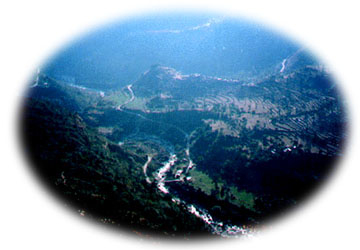
Alaknanda River Valley (RN)
Mountain, and Himalayan agriculture specifically, deviates substantially from the kinds practiced in less precipitous altitudes. Hill farmers the world over have adapted to the difficult geography, and the terrain has likewise influenced cultural modes in mountain societies. Patterns of land ownership, subsistence vs. surplus production, and level of market penetration have also been decisively affected.
However, traditional Himalayan agricultural systems and knowledge base are being steadily eroded by market pressures, bringing both economic and cultural changes in Uttarakhand. Age-old self-reliance has given way to dependency on imports from the productive plains, with their pesticide/chemical fertilizer-enhanced yields. Cultural domination from the plains also threatens Uttarakhand's traditional foods as an increasing taste for mill-polished rice is outcompeting mountain crops. Activists in the hills have responded with a Save the Seeds movement and are raising awareness about the need for agricultural biodiversity.
The following sites are recommended:
- Mountain Farming Systems - Comprehensive look at Farming in Uttaranchal
- Proceedings - International Symposium on Mountain Farming held November 2002 in Mussoorie
- ICIMOD - Mountain Agriculture Resources
- Jardhari & Kothari - Conserving Agricultural Biodiversity (Tehri)
- Agrobiodiversity - Article on the Future of Indian Agriculture (Kothari)
- UN Volunteers - Info on Beej Bachao Andolan
- Vandana Shiva - Research Foundation for Science, Technology & Ecology and the Navdanya Project
- Subsistence Strategies and Environmental Management - RS Negi in Cultural Dimension of Ecology
- Back to Traditional Farming - Humanscape (2001/1)
- R.R. 7.5.03
Traditional Agricultural Patterns in Uttarakhand
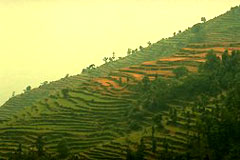
Terraced fields (I)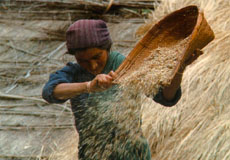
Threshing rice grain (AD)
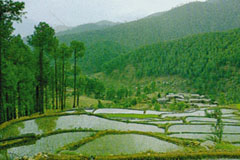
Rice paddies (AG)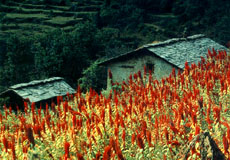
Amaranth fields (AD)
Agriculture is practised in the river valleys of Uttarakhand (a small 10-15% of the total land area). Over hundreds of years, many of the slopes have been cut into field terraces, a common characteristic of mountain agriculture throughout the world. The region's farmers have also developed advanced manure, crop rotation, and intercropping systems. Most land on the slopes is unirrigated. Three types of agriculture can be found in most river valleys. Each is particularly suited to the type of land. The three are:
- Katil - forest edge land
- hoe cultivation, with a standard rotation of 3 crops in 5 years
- major crop(s): a millet - "mandua/khoda" (Eleusine coracana), another millet - "jhangora" (Oplismenus frumentaceus), an amaranth - "marsa/chua/chaulai" (Amaranthus polygamous, Amaranthus blitum)
- Upraon - hillside land
- permanently terraced, but unirrigated
- major crop(s): mandua, jhangora, chaulai
- Talaon - valley bottom land
- paddy cultivation, low-lying, irrigated, double cropped
- major crop(s): wheat, rice, sugarcane, etc.
sub-region
(m)
Lower Dun, Terai
300-600
wheat, rice, sugarcane
Upper Dun, Bhabar, lower Shivaliks
600-1,200
wheat, rice, mandua, jhangora, chaulai, maize
Middle Garhwal-Kumaon
1,200-1,800
wheat, rice mandua, jhangora, "cheena" (Panicum miliaceum), potato, barley
Upper Garhwal-Kumaon
1,800-2,400
wheat, barley, potato, chaulai, cheena, "phaphra" (Fagopyum tataricum)
Cold Zone
2,400-3,600
SUMMER- wheat, barley, potato, phaphra, chaulai, "kauni", "ogal", "kodo" (Fagopyum esculentum), "uva" (Hoycleum himalayanse)
Various pulses (e.g., "Masur" - Ervum lens; "Kulat" - Dolichos biflorus) are grown intercropped during the two harvest seasons - early winter after the rainy season (millet) and midsummer before the hot dry season (barley-wheat). Dry and wet rice, taro, pumpkins, beans, corn, ginger, chili, cucumbers, leafy vegetables, and tobacco are also grown. Potatoes have become an important cash crop, growing in areas unsuitable for other plants (Berreman, 1963).
"The advanced nature of traditional farming in the region is illustrated by the practice of barahnaja (literally, '12 seeds'). This is the name of a sophisticated intercropping system of rainfed hill farming. Mandua (finger millets), ramdana/chua (amaranthus), rajma (common kidney beans), ogal (buckwheat), urad (green gram), moong (black gram), naurangi (mix of pulses), gahath (horsegram), bhat (soybean), lobiya (French beans) kheera (cucumber), bhang (cannabis), and other crops, are grown together in a mixture which is finely balanced to optimize productivity and maintenance of soil fertility, and is geared towards meeting diverse household requirements. In such traditional cultivation, farmers had to spend almost nothing on inputs, since seeds, organic fertilizer, and pest control were virtually free. Whenever they realized that conditions were suitable, they would start planting..."
Land Distribution
The pattern of land ownership is unlike that found in the rest of India. Most Uttarakhand farmers are owner-cultivators. Tenant farming and sharecropping are rare, and landholdings generally small and limited to family farms (Approximately 50% of all landholdings are less than 0.5 hectares in size, and 70% under 1 hectare). As such, the zamindari system of big landholders is limited to the plains. Both geography and Pahari cultural heritage has played a role in maintaining traditionally more equitable, if impoverished, land distribution in Uttarakhand.
Bibliography
Chandola, H. "What Kind of Uttarakhand?" In: Uttarakhand in Turmoil. (R.R. Nautiyal, A. Nautiyal, eds.) New Delhi: MD Pub.(1996), pp.13-17.
Dilwali, A., Pant, P. The Garhwal Himalayas, ramparts of heaven. New Delhi: Lustre Press, 1987.
Kharkwal, S.C. 1977. Geographic Personality of Garhwal. The Himalaya. 1(1):3-13.
Berreman, G. Hindus of the Himalayas. Berkeley: University of California Press, 1963.
Bhatt, K.N. Uttarakhand: Ecology, Economy, and Society Allahabad: Horizon Publishing, 1997.