 |
TOWARDS A NEW UTTARAKHAND: THE PROMISE AND PERIL NOTES FROM NORTH AMERICA |
Submitted by Rajiv Rawat
for the Workshop on the Governance
and Economic Transformation of Uttaranchal/Uttarakhand
October 27-28, 1998
1. Introduction
2. The Problem with "Development"
3. Reversing "Development"
4. Putting People First
5. A Departure from Business as Usual
6. Towards a New Uttarakhand
7. Literature Cited
8. About the Author
Uttarakhand appears verged on a new era of her often sad and troubled history. Although promised an "Uttaranchal" state by the current government, little else has been elucidated about the new creation, other than many of its resources will remain under the control of Uttar Pradesh, its parent state. Other than that, the current Indian political system has fashioned "Uttaranchal" in the mold of other states, with a sitting assembly, converted from current MLAs and tehsildars, and other such characteristics of representative democracies.
All this comes will little fanfare among many Uttarakhandis in North America, who have little faith in the politicians back home, and remain rather pessimistic about prospects for a brighter future under the present setup for the hills. As the logical extension of a money order economy that began at the turn of the century and accelerated in the post-independence era, Uttarakhandis finally reached the shores of North America by the 1960s. In recent years, with the resurgence of Uttarakhandi identity in the post-1994 period, the community has also coalesced, forming associations in Canada and the US. These Uttarakhandis living abroad have so far felt powerless to help raise Uttarakhand from her terrible poverty and reverse the disquieting trends that threaten the Himalayas' life-sustaining capacities. The recent landslides and 1991 Uttarkashi earthquake only served to remind them of the serious erosion of the ecological and geologic integrity of the Uttarakhand Himalayas, and how time might be running out for the motherland.
Despite their apparent helplessness, the North American Uttarakhandis yearn to do their part to save the Himalayas of their youth. However, having lived under the governing structures of other lands, these expatriates have not seen much promise in adapting the forms of democracy practiced elsewhere to Uttarakhand's myriad problems. Advanced societies, while offering material comforts, have not themselves solved the problems of political disenfranchisement and economic marginalization.
What follows are some discussion points and suggestions put forward by the Uttarakhand Support Committee hoping to contribute to the democratic process in Uttarakhand and India through insights gained from living abroad and from participating in global movements for social change.
THE PROBLEM WITH "DEVELOPMENT"
The experience of the development process in Uttarakhand holds many lessons, most of which unfortunately remain unheeded today. Indeed, the separate state movement had its genesis in the very failure of the process to bring any substantive improvement in the lives of the Uttarakhand rural poor. In truth, development has only impoverished the hills and visited ever more onerous ecological burdens on the people.
For Uttarakhand, forest policy has always been a key issue and indicative of how various administrations have approached development in the hills. From time immemorial, the people lived relatively harmoniously with the environment, cutting terraces into the hills and modifying nature without supplanting it. Uttarakhandis, much like their Andean, Swiss, and Nepali mountain brethren, "humanized" nature in a careful and sophisticated manner, deriving a level of material comfort from the Khals, Dhars, and Ghatis.
With the coming of the British, the forests were made to serve rapacious masters, whose own needs far outstripped the forests of their country (Guha, 1990). For years, "scientific forestry" stood for the maximum extraction of timber and forest products from the Himalayas. The "modern" management, under the guise of progress, led to the merciless plunder of the once green hills, while depriving Uttarakhandis of their forest rights. What little land left to the people was stressed to the breaking point, both grazed by herds and depended upon for fuel wood and fodder. By the turn of the century, the ancient ties of the people with the forest were severed, hastening the exhaustion of the land and heralding the coming of dependency and the money order economy.
Formal independence from Britain did little to change the situation. Indeed state planners inherited wholesale the colonial institutions and mindset of the British, treating the Uttarakhand Himalayas as an internal colony of an industrializing India. In a very real sense, Uttarakhand, like the Amazonian hinterland of Brazil and the tropical rainforests of Sarawak, Malaysia, has served as a source of raw materials for the rest of India (Karan, 1994). As such, the Uttarakhandi people and Himalayas endured the detrimental effects of industrialization with few, if any, of the benefits.
It was only with the awakening of the people through the Chipko Andolan did perceptions change. By the 1980s, the central government began incorporating the rhetoric, if not the goals, of the Chipko activists in their five-year plans (Bhatt, 1997). The new found ecological principles brought full circle the vision of the forests, recognizing the inherently exploitative and flawed theoretical grounding of scientific forestry, and the validity of the ancient, indigenous relationship with the trees.
The experience of the Chipko movement has also served to illustrate the possibilities and limits of NGO-led movements for social uplift and ecological remediation. As long as Chipko was involved in inspiring a grassroots-based, mobilization of the people towards an uprising against the prevailing economic order, the movement succeeded beyond all expectations as an expression of the people's struggle. However, as soon as the movement fell prey to personality politics and academic deconstruction, with important activists bogged down in the bureaucratic maze of administering government-sponsored projects, Chipko lost much of its momentum (Aryal, 1994a). As such, the Chipko movement has itself demonstrated the need for maintaining the activist spirit in the people, so that the people remain ever vigilant of their rights. This holds many lessons for scientists and administrators of a new Uttarakhand, whose advice will never be complete without the expertise and active participation of the rural folk.
Despite Chipko, the magnitude of the damage done to the hills by years of commercial extraction, misguided forest policies, and lax enforcement of well-intentioned laws has far surpassed any one movement's ability to deal with the coming catastrophe. According to estimates by S.L. Shah, the forests' natural regenerative capacity may be exhausted by 2031, if current trends continue. Moreover, overgrazing of the grasslands will deplete them by 2041 (Shah, 1986). Recent geologic studies have also reported the rapid retreat of the Himalayan glaciers, leading possibly to the Ganga drying up in the next century. These alarming predictions should imbue anyone with renewed urgency in solving the ecological crisis and putting Uttarakhand's and India's pressing environmental problems at the top of the national agenda.
As a significant demand of the Uttarakhand movement has been for the material well-being of hill residents, any discussion on the economic revitalisation of Uttarakhand has to address fundamental issues. Future administrative arrangements must recognize that the forests and natural resources of the land belong to the people. Moreover, the welfare of the people cannot be left to chance or to trickle down as a side-effect of some proposed development project. As seen by the Chipko experience, the people must have a full say in determining the direction of the economy. Rather than leaving these matters to experts, special interest groups, NGOs, governmental agencies, or international lenders, Uttarakhandis must themselves be empowered and responsible for planning and executing programmes to improve their living standards. Institutions that are accountable to the people alone must be established to carry out this mandate at the local, block, district, and state levels.
Furthermore, it behooves future planners to study the tremendous shifts in policy and philosophy that have marked world economies over the last few decades. In fact, the whole academic field of development, in response to the emergence of social movements, the onset of structural adjustment programs, and the process of globalization, has changed greatly from the early days of heavy industrialization through monumental infrastructure projects (McMichael, 1996). The development era was itself declared dead almost two decades ago, as globalized capital became the choice engine of economic growth. More recently, the collapse of the Asian economies has in turn dealt a damaging blow to the globalization paradigm, and time may soon tell whether its era has too passed.
With the turmoil and fluctuations in the world economic order, a new paradigm of indigenous solutions to indigenous problems has arisen, reinforced by the growth of social movements in the vacuum left by retreating governmental commitments to fulfilling people's basic rights. With a sustainable, steady-state, and comfortable standard of living for the Himalayas, Uttarakhand can meet her peoples' needs in harmony with nature.
The unfortunate experiences of other Himalayan lands illustrate well this need for a radical departure from conventional developmental modes followed in the rest of India. Ladakh, once a peaceful and culturally rich region, has seen the replacement of its subsistence economy with dependency, accompanied with the degradation of indigenous culture and erosion of self-esteem (Norberg-Hodge, 1991). The market pressures of subsidized food from outside the region have had a debilitating effect on the traditional agricultural systems, pushing subsistence farmers into insolvency. Communal conflict, never before an issue in a land where Muslims and Buddhists lived peacefully side by side, has emerged to further aggravate a tense situation. The forces of assimilation and Westernization at work in India and throughout the globalized world, have demoralized the Ladakhi people. The youth have been hardest hit, who, like their Uttarakhandi brothers and sisters, have found it difficult to find work in the new economy at home and elsewhere.
A new state will need to preserve and apply Uttarakhand's traditions to solving her problems, which are being aggravated by the very same modernization processes afflicting Ladakh. The teaching of Uttarakhandi culture and language in schools, funding for the arts, and traditional ecological principles should be promoted. Another important thrust would include the broadening of the save the seeds (Beej Bachao Andolan) movement for self-reliance through native seeds (Jardhari & Kothari, 1997). Fortunately, Uttarakhand has no dearth of activists, scientists, and radical thinkers, to help in these endeavours, although most have been rendered powerless to affect real change in their localities and on their particular issues. As such, an important goal of the new state would include empowering these people and translating their admirable efforts into mass actions.
All this calls into question the modernization impulse found throughout India, as aping the West has only benefited a distinct few, while subjecting many others to dislocation and pauperization. The West itself has turned this corner, and many have begun to challenge the constructed edifices of their own prosperity. For instance, the new trend towards smaller rather than large projects is one borne of the negative experience in the West with the displacing and anti-democratic effects of mega-projects. Although favoured by state planners and international funders, many of these plans have turned into so-called "White Elephants" - bottomless money pits, with no accountability to the public over their economic and environmental repercussions (Swami, 1995). In the case of Uttarakhand, the mountain ecosystem and geology further has complicated large-scale development efforts as witnessed by the controversy surrounding the Dams at Tehri and Vishnuprayag.
The following table illustrates this "small is beautiful" principle. Mini-hydro plants as alternatives to large dams in the Himalayas have been promoted for two decades now, and the time has come for their implementation.
Example of Changing Development Paradigms
|
|
|
|
|
|
|
|
|
|
|
|
|
|
|
|
|
|
|
With the energy generated by these mini-hydro plants, other, less damaging forms of economic growth could be promoted in lieu of sole dependence on natural resources. Schools could be established throughout the hills to train Garhwali and Kumaoni boys and girls in intellectual growth industries such as information technologies and telecommunications. The relatively clean air, cooler clime, and proximity to Delhi are factors that could favour jobs for a region that has been hemorrhaging the flower of its youth to the plains for decades (Bhatt, 1997). In addition, establishing more scientific and technical research institutions would assist people in solving their problems in agriculture and promoting indigenous innovations to aid in ameliorating the people's well-being. Such opportunities would change the face of the hills and should be seriously considered by the future state.
Other types of revenue-generating projects could include concluding new arrangements that better utilize the natural bounty of the Himalayas. Uttarakhand has a lot of water that goes to the plains. The new state should charge a royality for the water that goes to other states, or enter into agreements with these states to supply them with necessities in exchange. Uttarakhand should also ask for payment for the water, which the other states have used free of charge for the last fifty years, while Uttarakhandis have had to endure ever more severe shortages. The same would apply to hydroelectricity, another possible staple export of a new Uttarakhand state. Subsequently, this money could be used as seed capital for other projects.
Exploration and development of mineral wealth is another potential avenue of income. The mountains of Uttarakhand are rich in many minerals and metals, but lamentably, the means by which excavation has been carried out so far has been disruptive of the geology and has benefited very few people. Limestone quarries have scarred the lesser Himalayas, and attention should be paid to rehabilitating the ecosystem of surrounding areas. Likewise, resources have to be extracted in harmony with environment, so that they do not endanger the habitat and ecological balance, which has been the tradition of the people. These resources should not be exploited in a mindless manner, leading to short-term benefits for a few and long-term problems for many. Correspondingly, the people most affected by the disruptions should be compensated with a substantial share of the earnings.
Furthermore, tourism as a traditional wealth generator has not fulfilled the people's needs as it could have over the past few years. Derivative economic benefits have bypassed locals as well, since many, if not most of the tourist agencies, hotels, buses, and shops have been run by non-Uttarakhandis. A policy of hiring indigenous labour should be promoted to better serve the native hill residents. In addition, the trend towards tourism that is hostile to the people and the natural environment must be halted, and ecological and cultural sensitivity inculcated in all pilgrims and travelers. Plastic products should be banned and limits placed on resource consumption.
Much of the rest of the Himalayas are in desperate need of the solutions being sought in Uttarakhand. Even a casual observer will note that ecological degradation, poverty, and violent conflict afflict many highlands of Asia, from the Hindu Kush to the hills of Laos. The battered land of Kashmir stands at the flashpoint of conflict between India and Pakistan, and is suffering greatly from the military's presence and raging proxy war. The Tibetan nation is at risk of disappearing entirely and although her cause has been taken up by activists around the world, no government has yet recognized her right to self-determination. The Nepalese democratic revolution of 1990 has been squandered by political parties patterned after their Indian counterparts. Unable to provide stable government to alleviate desperate poverty in 8 years of multiparty politics, the mountain kingdom has, in response, witnessed the onset of a violent Maoist uprising and state repression that has brought the Nepal Himalayas a level of violence unheard of in two centuries. In India's northeast, simmering guerilla conflicts, some into their fourth decade, continue to rage, with rebel groups splintering into warring ethnic factions, further adding to the woes of the people. In Burma, the military junta continues its repressive policy towards ethnic minorities, even as it mops up the guerilla movement it recently crushed. Even Bhutan, long lauded for its dedication to environmental and cultural protection, faces a refugee crisis and calls for democracy.
In the case of Uttarakhand, the failure of the old economic and political system has had much to do with the marginalizing of the people's struggles and the most vulnerable sections of society - women, lower castes, and tribals. Consequently, it has been women who have formed the backbone of the modern movements, while the lower castes, the Kols and Doms, have become the last strongholds of Uttarakhandi traditions.
Hill women work an average of 16 hours a day, making them some of the hardest working individuals in the world (Pande, 1996). The scarcity of water, fuel wood, and fodder that results from deforestation have all exacted a heavy toll on women and have made their already difficult daily lives increasingly intolerable. Moreover, the introduction of all kinds of odious customs like dowry marriages from the plains, has further eroded the status of women. With only about a 40% literacy rate, hill women need political and social empowerment.
Likewise, lower caste groups have been severely impacted by declining living standards in hills. The same market forces that have rendered subsistence agriculture futile, have displaced native workmanship with finished products from the plains. Furthermore, cosmopolitan music and brass bands are threatening to supplant Garhwali and Kumaoni folk drumming, long a passion and source of income for low caste musicians (Chandola, 1996). The traditional caste hierarchy has also become more rigid with the sanskritization of Uttarakhandi culture, with dire implications for communal harmony. Years of domination by the upper castes have also, for good reason, made the lower castes apprehensive about the future (Aryal, 1994b). As such, the new state will need to commit itself to guaranteeing the human and civil rights of all its peoples.
Any solutions sought in the hills will necessarily involve the uplift of all segments of society, as equality is the most important prerequisite to true liberty. Without such efforts, any new Uttarakhand will prove meaningless, and the problems of castism and communalism, leading to social discord, will inevitably arise. Just as ominous will be the ongoing threat posed by the powerful criminal underground. Many social movements have arisen to combat the influence of the four L- mafias - land, liquor, lumber, and leesa - yet each has been undermined by the penetration of state agencies by these criminal elements (Husain, 1995). The new state, if controlled by such people, will only hasten the social and environmental disintegration of the Himalayas. As an indigenous class of contractors emerges to replace or collaborate with the plains-based exploiters of the hills, the protection of rights, empowerment of people, and rule of law will be fundamental to keeping such forces at bay.
A DEPARTURE FROM BUSINESS AS USUAL
Consequently, to avoid the pitfalls that have befallen much of the rest of India in the long quest for social development and political liberation, new modes of governing will need to be implemented. The problems are indeed daunting and will need radical conceptions of society that break from past ideologies, yet draws from their real life experiences. What is probably most needed throughout all of India and most pressingly in Uttarakhand, is a renewal of democracy and the reinvigoration of the institutions of people's self-governance. Although strengthening the democratic foundations will contribute to this, the experience of the last half-century calls for more fundamental departures from obsolete models.
The experience of the Uttarakhand movement of 1994 illustrates many of the shortcomings of the current version of representative democracy. One of the hallmarks of the movement was the attempt to exclude party politics from the fold, as politicians could not be counted on to objectively work for the good of Uttarakhand without renouncing their party affiliations and links to vested interests. Much of the movement had already been marred by interparty rivalry and conflict, as each sought to gain advantage by exploiting the real concerns and sentiments of the people (Aryal, 1994b). This behavior proved abhorrent to many Uttarakhandis, who rejected it by expressing hostility to the whole political establishment.
Furthermore, the Uttarakhand people have learned over the last fifty years to expect little from elected officials, from the local sarpanch and block pramukh, all the way to the district magistrate, MLA, and MP. The physical and emotional distance of villagers from their representatives has
negatively impacted officialdom's responsiveness to the electorate (Chandola, 1996). A closer capital in a smaller state will solve part of this problem, but the gulf between the people and the politicians is also a distinctive feature of representative democracy and can only be solved by finding new ways to govern.
Therefore, the first government of a new Uttarakhand state should convene a Constitutional Convention, where the people can meet and decide for themselves what form their government should take. This is the basis of most constitutional democracies, and it is clear that the Indian constitution, one of the most amended and lengthy in the world, needs serious revision. A new state can start the process by empowering its people to choose their own governance structures. By putting in place a consensus-based system, with representation from all sections, a new constitution could be drafted that would adequately reflect the people's wishes. Women, who hold Uttarakhand's fate in their hands, should constitute a majority position at such a convention, lest their presence be further marginalized, and their views, which have tremendous bearing on the hills, be discounted. Moreover, this exercise in crafting the constitution would lay the groundwork for mass participatory democracy, an essential element in the rebirth of the hills.
| Another measure that could help ensure more accountability of officials to their constituents is the institutionalisation of the Askot to Arakot yatra that visits every corner of Garhwal and Kumaon. The journey, now conducted every ten years to survey the social, ecological, cultural and economic fabric of the Uttarakhand Himalayas (Ramakrishnan, 1994), could be planned every year and undertaken by members of the legislative assembly. This would serve to better link the central administration with remote localities, and provide villagers access to their state government and a chance to air grievances. Politicians unwilling to face the electorate and travel the length and breadth of Uttarakhand would be embarrassed by public reproach as in the old days of dandak. | 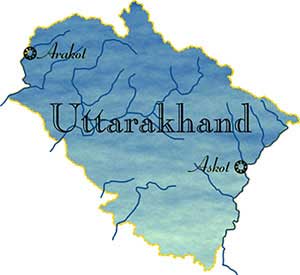 |
In the mean time, saving the Himalayan environment should be given top priority. The following suggestions warrant the new state's primary focus, as without attending to them, the Himalayas themselves might become uninhabitable:
- rejuvenation of the oak, deodar, and rhododendron forests, the backbone of the Himalayan woodlands and soil, and habitat to countless species of animals and plants
- introduction of renewable energy sources to every village to reduce dependency on depleted forests
- pollution reduction in Dehra Dun and Nainital - tough fuel emission standards, reduction of motor vehicle presence
- halt to illegal and substandard building in the hills - renewal of traditional earthquake and avalanche-proof construction methods
- halt to blasting for mining and road construction - exploration of other means to develop infrastructure
- complete ban on disposable plastic products - hazardous and unnecessary symbols of perverse status-conscious consumerism, should be part of India-wide drive to return to jute, hemp, and other natural fabrics
- possibly declaring entire Uttarakhand state a biopreserve to ward of further degradation and begin the arduous process of salvaging the mountains
- stringent requirements on pilgrims - those that consider the Himalayas the abode of gods should treat them as such
Finally, what has been proposed here represents only one more contribution to the growing body of literature pointing to the same pressing needs, and proposing some of the same solutions. Uttarakhand must not shy away from what skeptics and experts would consider "impossible", "impractical", or "politically unfeasible". India has endured 50 years of the "possible", with only a ravaged environment, violent polity, and disintegrating society to show for it. We must not be afraid to rethink old ideas and ideologies, discard those that have met with abject failure, and pursue those that hold the most promise. By learning from the experience of various social movements, of which Uttarakhand is especially famous for, we will not need to seek far for our answers. Furthermore, people-centered development should not remain mere rhetoric, propounded upon, but rarely enacted by state agencies. It has to lead to the very real empowerment of the people to determine their own future. The role of any new governing structure would be to serve the people in this endeavor, not to rule them or keep them in line, but to marshal the resources of the state, as no single individual can, towards the betterment of society as a whole, and as the people see fit. Only then, can we truly see a "government of the people, for the people, and by the people".
Uttarakhand must chart a new course, drawing upon her best traditions and the love of her sons and daughters, near and far. With a new state as a first step towards realizing the long cherished goals of self-governance and self-determination, a new Uttarakhand may hold the fate of India in her hands. If Uttarakhand fails, and becomes just another impoverished, corrupted, strife-torn state like Uttar Pradesh, the prospects for India's future could be irreparably diminished. If Uttarakhand emerges as an activist state, where the people are united and empowered, then the Himalayas will awaken to a new hope, showing the way for the rest of the country.
Aryal, M. 1994a. "Axing Chipko" Himal January/February, pp. 8-23.
Aryal, M. 1994b. "Angry Hills: An Uttarakhand State of Mind" Himal November/December, pp. 10-21.
Bhatt, K.N. 1997. Uttarakhand : Ecology, Economy, and Society. Allahabad: Horizon Publishers.
Chandola, H. 1996. "What kind of Uttarakhand?" In: Uttarakhand in Turmoil (Nautiyal, R.R., Nautiyal, A., eds.) New Delhi: MD Publications, 1996.
Guha, R. 1990. The Unquiet Woods: Ecological Change and Peasant Resistance in the Himalaya. Berkeley: University of California Press.
Husain, Z. 1995. Uttarakhand movement : the politics of identity and frustration, a psycho-analytical study of the separate state movement, 1815-1995. Bareilly: Prakash Book Depot, 1995.
Jardhari, V., Kothari, A. 1997. Conserving Agricultural Biodiversity: The Case of Tehri Garhwal and Implications for National Policy. Ottawa: International Development Research Centre (http://www.idrc.ca/books/focus/833/jardhari.html).
Karan, P.P. 1994. "Environmental Movements in India" Geological Review 84(1), pp. 32-41.
McMichael, P. 1996. Development and Social Change: a global perspective. Thousand Oaks, CA: Pine Forge Press.
Norberg-Hodge, H. 1991. Ancient Futures: Learning from Ladakh. Washington D.C.: Sierra Books.
Pande, P.N. 1996. Drudgery of the Hill Women. New Delhi: Indus Publishers.
Ramakrishnan, V. 1994. "For a brave new world: Why the people want Uttarakhand" Frontline October 7, pp. 13-15.
Shah, S.L. 1986. Planning and Management of Natural and Human Resources in the Mountains: A Micro Level Approach with Special Reference to the Central Himalaya. New Delhi: Yatan Publishing.
Swami, P. 1995. "Blundering Progress: The Tehri project and growing fears" Frontline June 30, pp. 60-64.
The author was born in Dehra Dun, but immigrated at the wee age of 1 with his family to Canada. As a social justice and environmental activist at Cornell University, the author worked on several student and community causes. Since graduating, he has endeavoured on issues particular to India and Uttarakhand. The author currently works and lives in Boston, Massachusetts, and manages an Uttarakhand website at: http://www.uttarakhand.org.
- R. R. 2.5.1999