
Press Release: August 11, 1998
Uttarakhand Support Committee
Issues Challenge to Politicians
BOSTON: The Uttarakhand Support Committee strongly deplores the recent steps taken by various Indian political parties to derail the process of creating Uttaranchal. The whole controversy surrounding the inclusion of Haridwar and Udam Singh Nagar in Uttaranchal has come at such a late stage in the state reorganization process, that the political machinations of various vested interests is abundantly clear. More distressing, but perhaps predictable in Indian politics, is the policy reversals of many of the major parties, as each has attempted to whip up communal tensions, baseless allegations, and artificial fears for their own political gain, without regard to the long-term consequences on communal harmony and trust. As such, the Committee calls on all parties to come clean and work for the uplift of all segments of society, without regard to ethnicity, caste, creed, or gender. The Committee also calls on the various interests that are interfering with the work of building Uttarakhand, to stop playing games with people's lives and to unite in common purpose for the welfare of the people and health of the land.
The Committee also wishes to express its despair over the lack of understanding of many of the politicians involved in this sordid drama. The true historical context to the battle over the Terai has been relegated to the rear, as issues such as culture and linguistic rights have been deceptively and cynically projected on the current impasse. By creating divisions, where none existed before, the process of carving up vote banks is destroying the fabric of the Indian nation and must stop. Justice can only come by uniting the people, with fairness and honesty as the guiding principles.
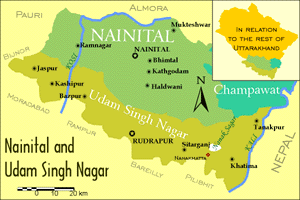
Udam Singh Nagar was carved out of Nainital district in 1995, ostensibly to provide better representation to the people living there. However, as recent events have borne out, the true purpose behind the scheme has now been rendered crystal clear - to carve the Terai out of Uttarakhand altogether, thus affirming and sanctioning once and for all the complete usurpation of the land from its original inhabitants.Indeed, the real issue of the Terai is the issue of land. Throughout the 1950s and 1960s, at the invitation of various state governments, migrants from other parts of India settled the region of Nainital district now included in the purview of Udam Singh Nagar. The land rush was accompanied by mass expropriations and the wholesale clearing of lush forest. Huge productive farms came into being, incidentally illegal in nature, as land ceiling laws in place to ensure a modicum of social justice in landownership were circumvented. The original inhabitants, the impoverished Buksha and Tharu peoples were pushed off the land, and in the end, have ended up landless or indentured to the new inhabitants.
This state of affairs is known to the big landowners of the Terai, as they realize that once Uttarakhand comes into being, the long suppressed aspirations of the people for social justice will finally be heard. As such, they fear profit losses, although no change in landownership has even been proposed at the current juncture. Indeed, recent proposals by the central government have introduced Article 84 into the Uttaranchal creation bill, effectively freezing land holdings and ensuring the continuance of the landed elite's dominance of Udham Singh Nagar. This is a huge concession, one granted by the central government and not the people. Being essentially an honest and forgiving people, Uttarakhandis will abide this injustice, so long as they are allowed to determine their own future in peace and harmony. However, if their dreams are frustrated by opportunistic elements fighting for short-term political gains and in support of wealthy interests, the Indian political system will stand exposed for what it is for so many: a tool of powerful interests to corrupt, co-opt, or crush the aspirations of marginal people, be they dalits, women, landless peasants, indigenous peoples, or ethnic minorities. As heirs to the British legacy of divide and conquer governance, Indian politicians can break from this historical precedence and affirm the rights of India's peoples, in this case, by creating Uttarakhand quickly, otherwise they will have affirmed the worst of what many have suspected all along.
Uttarakhand Support Committee
[email protected]
