

The events of Autumn 1994 reverberate to this day. Included here are some news excerpts and articles below to give the reviewer some sense of the hopes and sorrow that arose during the autonomy agitation in Uttarakhand.
- Press Clippings

- Pictures
- Key Events in the 1994 Movement (Timeline)
- Angry Hills Introduction to Manisha Aryal's Himal article
- Uttarakhand's Story of Statehood
- Uttarakhand: Nemesis of Indian Colonial Mindset
- Quotes from the Movement
- Patriotic People - Letter to the Editor
- People's Union of Civil Liberties (PUCL) View of Firings
- Abode of the Gods Going to the Devil?
- Reign of Terror in Uttarakhand
- Muzaffarnagar Firing Equals Jallianwala Bagh Massacre: Chipko Leader's Views
- Uttarakhand Activists' Views on Firing and Rape
- Uttarakhand Rapes: Unravelling the Cover-Up
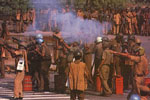
The Provincial Armed Constabulatory Tear Gassing a Crowd
(India Today)
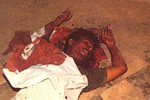
Victim of Police Firing
(India Today)
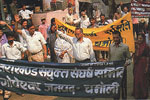
Commemorative Protest Rally in Chamoli
(India Today)
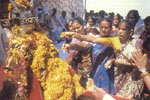
Uttarakhandi Women Paying their Respects to the Martyrs
(Outlook)
Some Key Events of the 1994 Movement
July 1994: Uttarakhandi students begin agitation through civil disobedience (sit down protests, blocking traffic). Initially concerned with the impact of 27 per cent OBC reservations in the hills, the movement spreads throughout Kumaon and Garhwal.
August 8, 1994: Uttarakhand Kranti Dal members on hunger strike are arrested by the police. Among the first of many violent episodes, activists resist with stone throwing that elicits a baton charge by the police.
August 17, 1994: State Government Chief Minister, Mulayam Singh Yadav makes an anti-hill statement that raises tensions throughout Uttarakhand. The Chief Minister threatens the activists with counter-demonstrations.
August 23, 1994: All of Uttarakhand observes a total bandh (shutdown strike).
August 31, 1994: Widespread protests are held against the extending of 27 per cent reservation for OBCs to the hill districts. Police tear gas and lathi-charge demonstrators at several places including Dehradun, Mussoorie, Pauri, Nainital, and Pithoragarh.
September 1, 1994: On the orders of the local SDM, police open fire on 10,000 rallyists at Khatima in Nainital that lasts for an hour and a half. Three reported killed, four missing, hundreds injured.
September 2, 1994: Police fire on demonstrators at Jhulagarh in Mussoorie. Seven people are killed, including the deputy superintendent of police, Mussoorie.
September 13, 1994: The Chief Minister of Uttar Pradesh organizes a counter bandh as a demonstration of his power. However, pro-reservationist forces end up sacking the Allahabad High Court, injuring attorneys and the court judge. The state police showed their political allegiances by failing to protect the bar. A CBI probe is launched.
October 2, 1994: Responding to a rally called by the Uttarakhand Samyukta Sangharsh Samiti (USSS), nearly 5,000 people begin a journey from Kumaon and Garhwal to New Delhi. The Kumaon buses arrive at the capital safely. Rallyists from Garhwal are stopped by police near Muzaffarnagar, tear-gassed, lathi-charged, and fired upon. The CBI says that [at least] five people were killed and seven women were raped. Several others are assaulted and injured.
"..the pre-dawn hours of 2 October were a nightmare for the Garhwali activists, most of them still asleep in their seats. "Hell broke lose at 5:30 am," wrote one reporter who was present. The police, members of the infamous Provincial Armed Constabulary (PAC), chased the Garhwalis towards the sugarcane fields, using tear gas and batons, shooting randomly and molesting women. A kilometre stretch of the road was said to be splattered with blood and broken glass..."
- Himal, Nov/Dec 1994, p. 14
- timeline adapted from India Today June 30, 1995 article,
"Uttarakhand Rapes: Unravelling the Cover-Up"
Angry Hills: An Uttarakhand State of Mind
The eight hill districts of Uttar Pradesh state that make up Kumaon and Garhwal have always made news quite disproportionate to their size and population. More than elsewhere in South Asian hill or plain, Garhwalis and Kumaonis have been fighters for social justice - whether combatting turn-of-century feudals to emancipate forced labour, daring the British in pre-Independence times, or fighting government and big business through the Chipko movement.
Today, the hill people are once again generating news. Their battle with authority is approaching a decisive juncture. After a period of relative quiet in the late 1980s and early l990s, when the Chipko and anti-alcohol movements had lost their steam, the hills are once again alive with slogans and mass action. The population demands Uttarakhand, not just a collective name for Kumaon and Garhwal, but a new state of the Indian Union to be wrested from Uttar Pradesh, The six million pahadis of Uttarakhand want the centuries of domination by "outsiders" and "plains people" to end.
While an undercurrent for separate statehood has always been part of the earlier agitations, it was only in the middle of 1994 that the final fuse was lit. Instead of fighting village overlords, the British, the timber mafia, or the hooch merchants, the hill people are this time challenging the reluctant power elites of the Indian mainland to redraw the map and give them a state·
- Manisha Aryal, Himal Nov/Dec 1994
Uttarakhand's Story of Statehood
The movement in the hills of Uttar Pradesh for a separate State of Uttarakhand is the biggest movement in the history of the region, even bigger than the famous Tilari agitation, which was launched in 1930 in the riyasat of Tehri Garhwal for people's rights over forests and forest produce...
The demand for a separate State of Uttarakhand and creation of local political outfits like the Uttarakhand Kranti Dal, the Uttarakhand Jan Sangharsh Vahini, the Uttarakhand Mukti Morcha, the Uttarakhand Party, the Uttarakhand Jan Morcha, the Uttarakhand Raksha Manch, the Uttarakhand Shanti Vahini, and dozens of action Committees is the expression of the demands of a neglected people. The genesis of the ongoing agitation is remarkable in many ways. It took off as a protest against the implementation of reservation for OBCs. Eventually, it resulted first, in the demand for including the entire Uttarakhand region in the list of the OBCs and then, in the demand for a separate hill State...
The question of Uttarakhand State is directly associated with the issue of the management of the Himalayan region. Failure in managing the Himalayan eco-system will lead to a catastrophe. An expert group of the Planning Commission recommended strongly creation of an apex body such as the Himalayan Development Authority (HDA) to address the major issues and to evolve a policy framework for effective management. The formation of a separate State of Uttarakhand will be a step in the direction of proper management of the Himalayas.
The Uttarakhand movement needs to be seen in the light of the historically independent identity of the region. The region was able to maintain its political, economic, and cultural identity from the earliest times to the late eighteenth century. The Malla occupation and Rohila invasion did not have a lasting impression on the life of its people and these incidents were merely passing phases of local history...
Today, socio-economic problems, large-scale unemployment, and the disillusionment with the State and Central Governments have given a new dimension to the question of Uttarakhandi identity... The people of Garhwal and Kumaon have also realised that they do not have different political ends to pursue or, for that matter different identities, to adopt, since they are a single people in all respects. The rise of Garhwal and Kumaon as two independent principalities has become irrelevant for them and a thing of the past. The only salvation, if there is one, lies in this identity...
One cannot ignore the fact that a new kind of socio-political alignment has emerged in the ongoing movement. Even during earlier times, such alignments emerged after every major political event, be it the Rohila war, the Gorkha occupation, or British rule. After each of these events, history was re-invented to legitimise the newly acquired socio-political status of certain people who emerged dominant in the changed political circumstances. This will also happen in the near future when a separate State is formed. But, this time, it will be the turn of the common man. And, the same current is flowing throughout Uttarakhand as the whole region is united in a cultural bond. Otherwise, the reaction to the brutal massacres in Khatima and Mussoorie would not have been equally intense throughout the region...
Uttarakhand's story since Independence has been one of persistent exploitation of its forests and mineral wealth and neglect of its people. The neglect of regional aspirations led to the emergence of this movement as early as 1952 when P. C. Joshi of the undivided Communist Party of India raised this demand. Even Pandit Nehru envisaged division of UP, with complete statehood for Uttarakhand. But G. B. Pant, who hailed from the same region, opposed the idea and that was the end of the matter as far as the national polity was concerned. Nehru, at the Srinagar Congress Session, advocated the idea of a separate administrative set up for the region.
The attitude of the Central Government is about to lead to the situation going out of control. The people are convinced that the Government is not at all serious about their demand. The sentiments of the local people need to be addressed properly, otherwise the Government would have to face a very piquant situation.
The region has more than three lakh ex-soldiers and ex-paramilitary personnel. Most women of the region know how to handle rifles. The Government got a taste of what might be in the offing when ex-soldiers took out well-attended rallies in the region wearing their uniforms.
Source: Suresh Nautiyal, The Observer (New Delhi), September 29, 1994.
Uttarakhand: Nemesis of Indian Colonial Mindset
Like it or not, people of India in general and of Uttar Pradesh in particular have always treated the mountain areas of Kumaon and Garhwal as their colonies. And this is the genesis of the present-day Uttarakhand movement for creation of a separate State.
Uttarakhand is the indigenous answer to some very indigenous policy of colonialism followed by mindless Indian rulers for long. And this despite the fact that some very bright sparks of leaders have come from this very area of Uttarakhand.
Our relationship with the mountains of Uttar Pradesh has been very colonial, benign but exploitative. From the time some enterprising Sikhs started buying Terai lands for a pittance to the present day, this exploitation continues. Notwithstanding the fact that some manipulative builders actually own a whole lot of hilltops, the hill areas of Garhwal and Kumaon interest the rest of India only as places of seasonal tourism or where the baba lok [rich people] attend some residential school in the protected and insulated environs of some very English sub-culture.
The "reservation policy" announced by Mulayam Singh Yadav, may have proved to be an igniting spark or the proximate cause, but the problem was brewing for far too long. It is not the absolute deprivation per se, which has brought all the Uttarakhandis together but it is the perceived policy, of deliberate deprivation of a whole people from the mainstream of job opportunities.
The people from hill areas of UP have descended to the plains in search of jobs ending up as schoolteachers, chhota babus, mundus in the Dhabas and, in some stray cases, as sharers of power at the Centre, making it a money-order economy or sorts. But, by and large, unemployment and perpetual poverty has been the fate of the people in Garhwal and Kumaon areas.
Exploitative colonialism does not have an unending life anywhere on the earth. The Garhwalis annd Kumaonis have come to perceive themselves as the "wretched of the earth" in their own homeland which, for all practical purposes and intents, is a place behind the beyond for the people from plains who see these places as some kind of punishment postings. Naturally, the people posted in the hills from the plains are not motivated for any meaningful development of the area. Some bureaucrat sitting in distant Lucknow can hardly have time, expertise, or sensitiveness to see the growth potentials of an area even as a tourist resort much less as a motor to further the economic growth...
But, then, as long as Uttarakhand remains part of the larger tract of land called Uttar Pradesh, it will have to remain subservient to the colonial masters even if they happen to be Indians from the plains. It is this realization that has led to the present-day movement for a separate State of Uttarakhand and there is really no reason for the country to resist this perfectly natural demand of a people to manage their own affairs without separating from the country. Autonomy is not a concession. It is a right. Uttarakhand region thus has a case for statehood.
A new State Reorganisation Commission, like the one of 1953 yore, should be also considered to carve out Indian States afresh. This should also serve to create separate states like western UP, which is only logical. The important thing is that the country should remain together. Personal egos of the ministers and leaders can wait.
Source: University Today (New Delhi), October 10, 1994, editorial
"KENDRA NE HUMKO KYA DIYA / SARA HIMALAYA KHALI KIYA"
What did the centre give us? They plundered the whole Himalayas!
- One of the slogans of the Uttarakhand Movement
"Most menfolk are away working in various jobs outside the region and many students have been picked up by the administration, leaving the women the task of carrying the movement forward. Women here have traditionally been very active and participated willingly in earlier movements in the region such as the Chipko movement of the early 70s and the movement for prohibition later and this is a much more sensitive issue which involves the future of the coming generations."
- Shanti Devi Nautiyal, member of the Uttarakhand Joint Action Council (USSS), Rishikesh
The mountains are inherently tranquil - Charu Chand Chandola, local poet
Pahar ka swabhav hai chup rehna
Nadiyon ka bahte rehna
Jis din lagegi unke swabhiman par chot
Pani main paida hogi aag
Pathar-pather ban jaega bam
The rivers flow ever placidly
Yet the day their nature is hurt
The rivers will run with fire
And the Himalayas will explode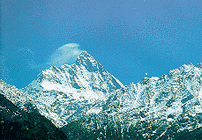
"I do not deny it completely. But I want to draw your attention to a fact that women hid themselves in the sugarcane fields when the brickbatting was going on· You see, it is human tendency. When a woman is seen at a lonely place in the jungle, any man will be inclined to rape her. In this particular case, I will certainly hold investigation."
- Muzaffarnagar District Magistrate Anant Kumar Singh who gave the orders to shoot on October 1 & 2. He justified his actions and denied the death toll in an interview with the Pioneer
"What would you do if your brothers were mowed down or your sisters raped by policemen?"
- Anonymous Uttarakhand Activist
...The two districts of Garhwal and Kumaon are two major recruiting areas and provide nearly 20 per cent of the personnel for the armed and paramilitary forces. They have a glorious history and an outstanding battle record. They are known for their gentle behaviour throughout the Indian Army. Their present agitation against reservation involving even women shows to what desperation they have been driven to.
It was the Garhwali battalion which had refused to fire at the Khudai Khidmatgars of the Frontier Gandhi, Khan Abdul Gaffar Khan, in Peshawar in 1930. No other unit can claim such patriotism during the British Raj.
Source: Col, S.R. Nanda (Retd.), The Hindustan Times (New Delhi),
September 28, 1994, letter to the editor.
Peoples' Union of Civil Liberties (PUCL) Views on Firing
The unprovoked and unjustified firing by the UP police, resulting in a score of deaths on Uttarakhand supporters is most condemnable. The firing on processionists who were peacefully proceeding to Delhi, shows that the claim of the UP Government to be sensitive to the demand of the poor people is hollow and false. The Government has denied the people the right to exercise their fundamental rights to freedom of speech.
Coming in the wake of the UP Government's involvement in the Allahabad High Court incident [government organized pro-reservation demonstrators ransacked the court, injuring several attorneys and the presiding judge], the latest police killings call seriously into question the credentials of the UP Government. The PUCL demands a judicial inquiry by a High Court Judge and payment of compensation to the next of kin of the dead and the injured.
Source: Rajinder Sachar, President (PUCL), Hindustan Times (New Delhi),
October 7, 1994 letter to the editor.
Blood stains mark the route to the hill districts of Uttar Pradesh - the curfew-bound abode of the Gods. Repeated police firings, an official death toll of 25, which keeps mounting, allegations of gang-rape and mass-rape of women by the constabulary, and marauding policemen arresting people at random mark the restoration of "law and order."
It is almost as if a primordial manthan (churning of the oceans) has taken place in the normally placid mountain sides. Nobody, shouts slogans any more...only the eyes reflect the dark abyss of determined fury.
Ex-servicemen including those who have retired from the police and paramilitary forces, have refused to surrender their licensed weapons. "Where are our boys?" the old soldiers have begun asking, determined to transform the unruly students into disciplined soldiers of a new self-assertion.
"From what I see and hear, I just can't understand why the administration is doing this," Prof. I. Punjabi of the Jawaharlal Nehru University - and a member of the Indian delegation to the UN Commission on Human Rights said in bewilderment. "In Kashmir, one can still find excuses - insurgency, the foreign hand... but here...?"
The hills were just sputtering back to normalcy when the "Massacre at Muzaffarnagar" broke the shattered calm with blood-strewn streets and bullet-ridden bodies. "This shouldn't have happened," a Station Officer posted in one of the Dehra Dun Police Stations confided, "I still don't understand the reason for the firing. I personally sent the message asking whether the buses carrying demonstrators to Delhi should be stopped, and was told to let them proceed after searching them for possible arms. I personally stopped and checked 46 buses. We faced the usual routine barrage of abuses. We searched all the buses and let them go since there was nothing which could be remotely used as an instrument. I asked for instructions once again and was told to let the buses proceed."
At the foothills near Muzaffarnagar, the State Government had prepared a reception committee late in the night. Trucks plying the highway were summarily requisitioned to block the tri-junction and buses from all over the Garhwal hills trapped in a police prepared funnel - one hundred buses at the mimimum - were surrounded by hundreds of armed PAC men.
As the news of the massacre spread into the hills, angry groups stormed Police Stations and came out onto the streets. With reports of missing women and girls streaming in, even the old and the infirm wanted to know: Why?
Almost spontaneously, the local constabulary in the hills stood apart from the new recruits sent to "teach the Paharis a lesson", and shops downed their shutters waiting for the echoes of anger. The administration had to impose curfew and call in Central help, and the Rapid Action Force was deployed since the traditional police forces did not act on the one sentence command "Bhoon do..." (finish them) which came over loud and clear over the wireless sets.
Tension within the police forces were also apparent. The Central Reserve Police Force has reportedly told the PAC platoons to remain within their own parameters and senior army officers are worried about the possible repercussions on the Garhwal and Kumaon regiments. No leave is being granted to soldiers from these regiments so that they do not go to their charged homes.
In Uttarakhand, there is no debate any longer, Uttarakhand IS. "The Himalayas were formed by a tumultuous upheaval... Siva's tandav nritya started here..." and the wizened old Chand Singh Dondiyal looked away from the plains and towards the peak.
Source: Chand Joshi, Hindustan Times (New Delhi), October 7, 1994
Reign of Terror in Uttarakhand
It seems that an undeclared emergency has been imposed in the Uttarakhand region and brutal forces like PAC and the forces from other States have been deployed to crush the people and terrorise them. In curfew-bound areas people are forced not to even peep out of the houses, The activists are being taken away to undisclosed places with the use of force. They are being denied their democratic and basic rights. All tools of terror and repression are being used freely to crush the mass movement.
The government has turned indifferent completely instead of providing a healing touch to the wounds after the Muzaffarnagar incident. In such a situation, tendencies of alienation are sure to occur. It would not be surprising if some outfits with militant outlook come into existence in the near future.
The people believe that there is no point in holding the UP state together at the cost of bloodshed at a time when they have already seceded from the State mentally and emotionally. There is no point in denying the people their basic right simply because Congress has to fight elections in some States in the near future and if it dismisses the UP government, it will loose the elections.
The aggression on these people in the form of State terrorism has once again reminded them of the Gorkha aggression, which was equally brutal. Today, the whole Uttarakhand is vibrating with aggressive slogans. The participation of women and students is unprecedented and overwhelming.
Source: The Observer (New Delhi), October 10, 1994
Muzaffarnagar Firing Equals Jallianwala Bagh Massacre: Chipko Movement Leaders Views
Leader of the famous Chipko Movement in UP hills and Magsaysay Award winnner Chandi Prasad Bhatt... expressed shock and deep anguish at the recent incident in Muzaffarnagar, where over a dozen Uttarakhand activists were killed in police firing and several women molested by the PAC personnel while they were on their way to attend a rally in the Capital.
On his return... from a two-day fact-finding visit to the site of the gruesome incident and nearby villages with a team of Gandhi Peace Foundation members, Mr. Bhatt stated it was clear from eyewitness accounts of the villagers that the local police and administration had, in a calculated move, unleashed a savage attack on thousands of unarmed men and women protectors of Uttarakhand.
Comparing the police action with the infamous Jallianwala Bagh massacre during British rule, the Gandhian leader charged UP Chief Minister Mulayam Singh Yadav with having deliberately engineered the violent incident to terrorise the peaceful hill people of the State. The Central Government also shared responsibility for the despicable incidents as it continued to support the Mulayam Singh Yadav Government...
At a Press Conference, they narrated their findings about the sequence of events on the fateful night of October 1 and early morning of October 2, as gleaned from the accounts of the villagers and rallyists present on the spot. They recalled that the 5 km stretch of road near Rampur Ka Tiraha was littered with tell-tale signs of police brutality, like broken glass and bloodstains, even two days after the incident. This despite frantic measures by the administration to cover them up.
Mr. Bhatt stressed that it was a matter of great shame and sorrow "that such "barbaric violence" had been perpetrated and women dishonoured on the 125th birth anniversary of Mahatma Gandhi. He was, however, all praise for the helpful and deeply sympathetic attitude of the Hindu and Muslim residents of the five nearby villages who provided shelter, food, and protection to the shattered hill people. These saviours included Hindus, Muslims and even Dalits and hailed from villages Sisona, Bangaunwali, Medhpur, Budhedi, and Rampur. A bhandara (kitchen) was hurriedly set up by the villagers to feed about 15,000 rallyists, who were also given clothes and treatment.
Source: Hindustan Times (New Delhi), October 7, 1994
Uttarakhand Activists' Views on Firing and Rape
Two women who were witness to the molestation of the women supporters of Uttarakhand and the assault on men by police in Muzaffarnagar on the night of October l, have claimed that the police firing was pre-planned by the "Centre and State-Government."
The women, Mrs. Kaushalaya Debral and Mrs. Sushila Dhayani, were part of the contingent of Uttarakhand supporters from Chamoli and Dehra Dun on their way to the rally in Delhi. They arrived at the spot, five hours after the outbreak of violence at 9 p.m., which continued for the next nine hours.
Addressing media persons, the women lambasted the PAC and the local administration, which had denied all reports of rape, molestation, and the killing of supporters that fateful night on a desolate highway bordered by sugarcane fields and a canal.
Refuting reports of the male supporters being armed, Mr. H. P. Bhatt, president of the H N. Bahuguna University Srinagar Teachers' Association, said that there was no incident of policemen or Government officials getting injured.
The women recounted the incident: "As our buses reached the area, we found the road blocked by trucks loaded with coal. There was no space for us to squeeze past. The PAC broke the headlights of our buses so we could not see. Interestingly, by 5 a.m., water tankers had reached the spot to clean the road of the blood stains." The women maintained that the violence was unprovoked.
The account given by Mrs. Dabral and Mrs Dhyani was reinforced by Mrs. Neeru Vohra, a lecturer of Delhi University, who recently visited the spot on behalf of the Gandhi Peace Foundation. "There are no contradictions in the account given by the residents of all five neighbouring villages who gave shelter to the men and women who fled police atrocities."
Source: Indian Express (New Delhi), October 9, 1994
Uttarakhand Rapes: Unravelling the Cover-Up
For eight months, she has carried the memory of that one night. And on the second day of every month, 22-year old Pauri resident Shakuntala Kumari joins other women who sit huddled in empty school grounds or deserted corners of government offices. They recollect how they were raped and molested by the state police on October 2, 1994.
The news is old, the memories fresh. Shakuntala recalls how she had to cover her face with a shawl when the policemen raped her. She was in one or the buses carrying Uttarakhand activists, who were on their way to New Delhi to take part in a rally, They were protesting against the Mulayam Singh Yadav Government,s decision to extend 27 per cent reservation for OBCs across the state, including the hill districts. The rallyists were stopped near Muzaffarnagar: the brutality that followed and the state's subsequent denials help Shakuntala like countless others involved in the Uttarakhand movement, to remember what lies ahead.
That, however, is in the future. The wait as of now is for July 3, when the CBI is expected to submit its final report to the Allahabad High Court on the human-rights violations against Uttarakhand activists by the Uttar Pradesh Government. Its last report, submitted on May 15, is a damning indictment of the Government and reads like a blotter of state repression...
...This too the state Government had denied. its line being that the men are still missing. But the gaping hole in the official version involves a clash between Uttarakhand activists and the state police at Khatima on September 1, 1994. After the clash, in which police fired on protestors, seven people were charged by the state for with causing damage to public property. The CBI, however, claims that three of those named in the charge-sheet were killed in police firing.
And the list goes on and on. Virtually every claim made by the Government does not stand under scrutiny by the CBI. This was expected ever since October last year when the Allahabad High Court directed the CBI to probe the allegations and the Uttar Pradesh Government had strongly resisted the move...
...For those who went through the Muzaffarnagar ordeal, the story is one of trauma. The state government claims that statements made by the alleged rape victims did not prove that rapes had taken place. This has flared up tempers. One of the rape victims, Sneha Kumari, 39, told India Today: "It takes a lot for a woman to admit that she has been beaten in her private parts with a rifle butt, abused in the worst way and then gangraped by three PAC constables. But I did. I told them the truth."
Another victim remembers the details. "There were 27 of us in the bus when the attack began." recalls Usha Bhatt, 42, president of the primary schoolteachers' union in Gopeshwar. "I pleaded with the constables and told them that we were all like their sisters. One of them said, 'Tum to Uttarakhand ki saaliyan ho'. But the worst was yet to come. Police constables got onto our bus, reeking of liquor. The hit us with rifle butts, pawed at our breasts, snatched our chains, purses, anything they could get their hands on." Last fortnight, Bhatt on behalf of 12 other victims of rape and molestation, filed an affadavit in the Allahabad High Court, rejecting any form of government compensation and reiterated the demand for a separate state of Uttarakhand.
In fact, it's the demand that helps the victims of Muzaffarnagar fight their personal tragedies...
(Names of the rape victims mentioned have been changed to protect their identity.)
- Excerpt from India Today June 30, 1995 article,
"Uttarakhand Rapes: Unravelling the Cover-Up"