

Excerpts from The Historical Record of the 39th Royal Garhwal Rifles
Vol. 1. 1887-1922, Compiled by Brigadier General J. Evatt, DSO
The Great War, 1914-1918

IN REMEMBRANCE OF OUR DEAD
THEY SHALL NOT BE FORGOTTEN
"The units of the Indian Corps may justly claim that they had the good fortune to arrive at the very moment when their services were most required to relieve a very desperate situation. The British army, consisting of battered, war-worn, and almost exhausted troops, was fighting against terrible odds, and was practically without reserves. The offensive towards Lille had been brought to an abrupt conclusion and for some days the Germans had been attacking heavily along the whole line from La Bassee to Messines."
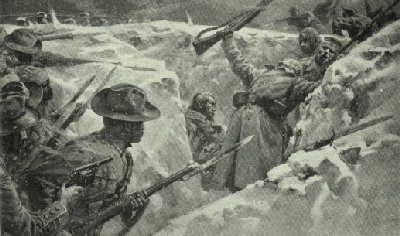
Naik Dharwan Singh Negi and the 1st Battalion at Festubert, 1914
"This section of the British line may be described as one of the least attractive, either from the picturesque point of view or that of comfort. During a great part of the year there stretched, as far as the eye could reach, a dismal sea of mud over which any rapid movement was almost impossible, and on a typical winter's day a steady cold downpour converted the fire trenches into fetid, water-logged ditches, and such communication trenches as existed into bottomless muddy streams. The drear and chilly discomfort of tlne whole scene was enough to appal the stoutest heart. In surroundings like these the feelings of Orientals cannot be described, and can hardly be imagined."
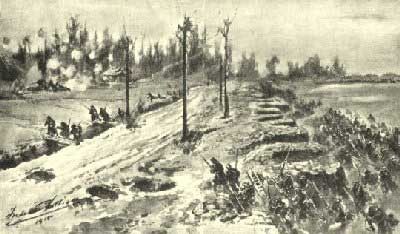
Battle of Neuve Chapelle, March 10-13, 1915
"The new-comers were greeted by a downpour of rain and with heavy firing from the enemy, and the long list of casualties suffered by the Regiment at once commenced. The trenches were early subjected to 8-inch howitzer shell fire, that on the 1st Battalion being especially heavy. The bearing of the men of both battalions during their first experience of a bombardment was extraordinarily steady."
A Group of Garhwali Officers c. 1915
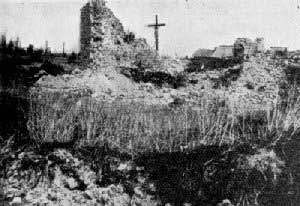
The Church at Neuve Chapelle: The Ruins of War
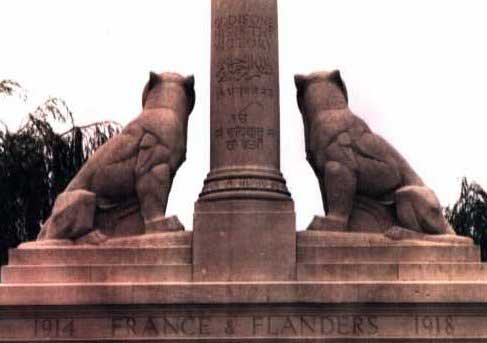
Memorial to Indian Soldiers at Neuve Chapelle
"From first to last the Garhwalis did splendid work, proving themselves to be really gallant soldiers, and their very heavy casualties attest to the fact that they bore a lion's share in Flanders. At Festubert in 1914, and at Neuve Chapelle nothing could have been better than their elan and discipline.
"The 39th Garhwal Rifles was a remarkably smart and clean regiment - both battalions did most gallant service, and proved themselves second to none in India. They left a name which will be held in high esteem by all who ever knew them in France, and not least by the Germans."
- General Sir James Willcocks (Corps Commander)