|
Text by Rajiv Rawat
With assistance from Sunil Kainthola & Satish Negi
© 2003 All Community Rights Reserved.
Current Date:
Page Last Updated:
November 11, 2003
|
People vs. Park Conflict, 1982-1998
In 1988, the Nanda Devi national park was converted into a full-fledged biosphere reserve. The NDBR was to be one of 14 established throughout India to represent the country’s vast biological and geographic diversity. Originally formalized by the United Nations Educational, Scientific, and Cultural Organisation (UNESCO) in 1970, the biosphere reserve concept represented a way to conserve areas of high ecological interest. Integral to reserves was the Man and Biosphere (MAB) programme that sought to harmonize the development aims of local communities with the protection of the reserve. The Indian National MAB Committee was constituted in 1979 to carry this mandate forward, establishing the NDBR as their second official biosphere reserve.
The creation of the NDBR extended the boundaries of the park, retaining the original sanctuary as its core zone and creating a new buffer zone that now encompassed the village lands themselves. Although under MAB guidelines, buffer zones were supposed to remain open to subsistence use by resident communities, in practice, further restrictions on livestock grazing in certain additional regions emerged to compound the loss of the core zone. With diminished pastures, overgrazing developed into a serious problem, leading many shepherds to reduce their flocks, and consequently wool production in the villages. Likewise, the reduced availability of fuel, fodder, and other non-timber forest products rendered the traditional subsistence-based agriculture in an even more precarious state.
Most upsetting was that the reserve was imposed unilaterally, without community consultation or any regard to the consequences for local livelihoods. Local participation in managing the reserve remained virtually non-existent, despite being common practice in similar protected areas around the world. Alternative income generation and development programmes were either too slow to address the crisis or were incompatible with the culture of the communities. Moreover, villagers took pride in their way of life, and wanted to maintain their independence as opposed to entering into a dependency relationship with governmental agencies. That poaching of large mammals continued unabated in both the buffer and core zones, leaving many to question the viability of such a restrictive conservation regime when its primary function had been so effectively undermined. As such, despite the best intentions of NDBR management, its top-down style of functioning, belatedness in response, inappropriateness of proposed remedies, and the inability of authorities to enforce their own regulations, all combined to turn people decisively against the reserve.
Reclaiming the Land, 1998
By 1998, after years of pleading and protesting their case, inhabitants of the Niti Valley again prepared for direct action. Under the inspired leadership of the Lata Village Chief, Dhan Singh Rana, people from ten buffer zone villages entered the core zone en masse, presenting a series of demands to the government for restoration of their traditional rights and roles as guardians of the Nanda Devi sanctuary. Compensation for their losses and a full accounting of funds spent on their behalf were also requested. Many of the same women who had earlier participated in the Chipko movement were again at the forefront of this new agitation, and although Gaura Devi had died a few years earlier, both her parental and adopted village of Lata and Reni were well represented. The villagers vowed to continue this Jhapto Cheeno (swoop and grab) movement and present their case in various platforms until the government recognized their claims.
|
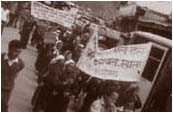
Procession through the streets of Joshimath
By Dhan Singh Rana
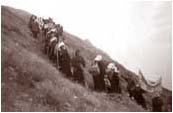
Descending into the core zone
By Dhan Singh Rana
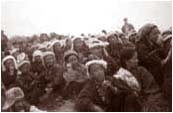
Core zone meeting
By Dhan Singh Rana
Group photo with banner
By Dhan Singh Rana
Declaring victory!
By Dhan Singh Rana
|

