
July 25, 2003
This past April, after a long struggle by local Bhotiya communities and extensive deliberations by forest department officials, the Uttaranchal government opened up the Nanda Devi Biosphere Reserve (NDBR) to limited tourism for the first time in 20 years. The new plan will allow 500 visitors to visit the reserve per annum, while maintaining exclusive management rights for the local villagers. The sensitive core zone will remain off-limits except for a 4-km trekking route extending into the core. The effects of the tourist trade on the delicate alpine ecosystem will be closely monitored and future plans established accordingly.
The lifting of the restrictions comes after the first attempt by the new state government to explore the tourism potential of Nanda Devi ended in a fiasco. In 2001, the Bhotiya leadership and forest rights activists raised the alarm against the Indian Mountaineering Foundation’s (IMF) expedition to Nanda Devi on behalf of adventure tourism companies based in Delhi and abroad. Originally ousted in the creation of the park in 1982, the Bhotiya of the Niti Valley had recently launched in 1998 their own agitation to regain access to the core zone and feared that the entry of high-end tourism outfits into the NDBR would again deprive them of control and ownership over their collective destiny. The issue became so heated that the state government, the union ministry of environment and forests, and park authorities all disowned the expedition, forcing an embarrassed IMF to shelve their ambitions.
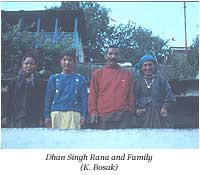
However, the Bhotiya, led by visionary leaders such as the Pradhan of Lata Village, Dhan Singh Rana, and assisted by seasoned activists such as Sunil Kainthola, seized the opportunity to prepare their own community-based eco-tourism plan. Declaring their intention to develop a tourism industry free of human and natural exploitation, the people of the Niti Valley congregated with friends and allies in Joshimath to map out their needs and next steps. By the end of 2002, with the appointment of a sympathetic and competent forest officer as director of the NDBR, consultations began for the incorporation of community aspirations into the mission of the biosphere reserve. The current plan unveiled in April 2003 thus aims to balance biological conservation, economic development, cultural preservation, and sustainable eco-tourism practices.
- R.R.*
* Condensed from a case study presentation by Keith Bosak and Rajiv Rawat: "Local Control and the Nanda Devi Biosphere Reserve" at the Sustainable Mountain Communities Conference in Banff, Alberta, June 14-18, 2003.
Additional Resources
- Namche Conference Presentation Abstract (2003/05/24)
- Nanda Devi Workshop Report (2001/10/29)
- Nanda Devi Workshop Presentation (Powerpoint)
- Nanda Devi Declaration Text (2001/10/14)
- Biosphere Reserve Details (WCMC Archives)
Encompassing the unique and breathtaking Himalayan wilderness region surrounding the Nanda Devi peak, the NDBR covers over 2236.74
km2 of the Uttarakhand Himalayas. Glaciers in the north, south, and east of the reserve feeds the Rishi
Ganga, which runs through the centre of the reserve on its way westward to the Dhauli
Ganga, a tributary of the Alaknanda. Nanda Devi, the focal point of the reserve and India’s second highest peak stands at 7,817m. Incredibly, Nanda Devi itself is guarded by some of the highest mountains in the Indian Himalayas, 12 of which exceed 6,400m (21,000ft) in height, further elevating its sacred status as the bliss-giving patron goddess of Uttarakhand and daughter of the Himalayas in local myth and folklore.
Although snowbound for half the year, the NDBR’s uniquely moist microclimates provide a veritable oasis for Himalayan flora and fauna. The high altitude alpine meadows and thick pine and deodar (Himalayan cedar) forests characteristic of inner Himalayan valleys have also provided homes to numerous species of large mammals (i.e., musk deer, snow leopards, Himalayan
tahrs, and black bears) and song birds (i.e., warblers, finches, and grosbeaks). Hundreds of species of trees, shrubs, and herbs also grow in the core zone, making the whole reserve a hotspot for biodiversity.
 About the People
The Bhotiya who inhabit 17 of the 19 villages found within the NDBR are an ethnically Tibetan people who have long straddled the Indo-Tibetan frontier and plied the trade routes through the Himalayas. In 1962, the India-China War closed the Uttarakhand-Tibet border indefinitely, abruptly ending an ancient source of livelihood. In the 70s, pressure on existing forests by commercial contractors led to the launch of the Chipko movement whose defining moment included Gaura Devi, a Bhotiya elder, saving her community forest with the help of fellow village women from Lata and Reni villages.
During the late 1970s, trekking and mountaineering expanded enormously in Nanda Devi, making the region the second most popular Himalayan mountaineering destination after Everest, but also leading to heavy pressure on the Nanda Devi ecosystem. Citing environmental concerns, the central government imposed the Nanda Devi national park in 1982, severely restricting activity in the buffer zone and denying further unauthorized access to the core. In 1988, the park was added to the register of UN World Heritage Sites as a biosphere reserve. Various attempts by park authorities and government planners at redress and economic development for the Bhotiya largely failed, culminating ten years later in renewed agitation for local access and rights.
Posted:
July 25, 2003
Updated: July 25, 2003