
 |
 56K FORMAT |
| Kali Raat [Real Audio (17:00)] |
| Delhi Rally Ma [Real Audio (8:00)] |
| Chander Singh Garhwali [Real Audio (5:00)] |
| Badri Vishal Teri Jai Ho [Real Audio (6:00+)] |
| Border Bit Joo Baudi Ni Ainee [Real Audio (6:00+)] |
| Tilai Gharoo Bola [Real Audio (5:00+)] |
| Chhooma Bau [Real Audio (3:00+)] |
| Uttarakhand Pyaru [Real Audio (3:00+)] |
| Tando Re Tando [Real Audio (5:00+)] |
| Pali Gharundha [Real Audio (5:00+)] |
| Gharya Motor [Real Audio (5:00+)] |
| Hinwali Kanti [Real Audio (5:00+)] |
| Slow Lament (Negi) [Real Audio (4:00+)] |
| A Duet [Real Audio (4:00+)] |
| Almora (Bakrola/Nirala) [Real Audio (4:00)+] |
| A Sweet Melody [RealAudio (2:36)] |
| Sadness for Kumaon and Garhwal (Negi) [RealAudio (4:00)] |
 FORMAT |
| A Hymn to the Himalayas, land of heroes [937 KB (1:59)] |
| A Kumaoni Gheet [370 KB (0:47)] |
| Rahi provides a brief introduction in Garhwali to each of the following drum jams [779 KB (1:39)] [882 KB (1:45)] |
| Rahi Sings [388 KB (0:49)] |
| Flute Solo [181 KB (0:23)] |
| Negi Introduces a Song [195 KB (0:24)] |
| Portions of Negi's Popular Songs [484 KB (1:01)] [409 KB (0:52)] |
| A Typical Folk Jig [621 KB (1:19)] |
| Anuradha Nirala Sings w/ Negi [647 KB (1:22)] |
| Beat of India hosts sample music from several Kumaoni artists. |
| Franck Bernède, an ethnomusicologist from France, recorded a series of epics and trance music for the Musée de L'Homme Le Chant du Monde series. A CD compilation can be obtained here. |
|
|
 |
 |
 The Music The MusicThe Uttarakhand Himalayas have inspired generations of singers, balladeers, and musicians throughout the ages. Both the natural beauty of the mountains that inspires a deep spirituality, and the harshness of life that darkens the heart with adversity and anguish, have invigorated Uttarakhandi music, heightening its poignancy and enriching its lyrical texture. Although, increasingly influenced by trends in Hindi film music (with Garhwali and Kumaoni songs set to filmstyle music), the more traditional forms of Himalayan music have remained deeply popular. This has been especially true of the Pahari penchant for folksy values, biting humour, raw honesty, loving devotion, and soaring spirits that shines through each song. Indeed, in face of other homogenizing trends in India, Uttarakhandi music has distinguished itself in retaining its cultural uniqueness and vibrant sound, while remaining popular among the masses. - R.R. |
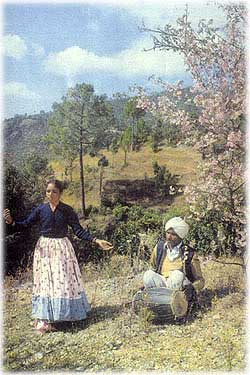 Baadi Couple |
| Singers
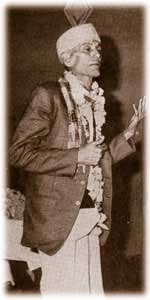
Narendra Singh Negi is perhaps the most widely recognized singer of the hills. His voice resonates with the Uttarakhandi languages he sings in (mostly Garhwali, but sometimes Kumaoni) and is as prolific to the Pahari genre as Lata Mangeshkar is to Hindi film music. Chander Singh Rahi, another popular singer, is both a balladeer and storyteller. His recordings are perhaps the most authentic to the hills, and he incorporates many legends and folk tales into his rousing songs. |
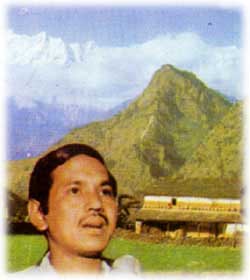 Narender Singh Negi |
|
|
|
| Baadi Traditions
Other than the popular recording artists, Garhwal and Kumaon have a long tradition of wandering musicians and bards. These folk artists, known commonly as the baadi have traveled among the hill villages for millenia, carrying folk legends from valley to valley. Their oral traditions have served to preserve the old folklore and history of the Himalayas. According to Ganesh Saili, Baadi songs can be classified in four categories: PANWARAS or ballads: ACHARI-GEET or fairy tales: MASAN, PRET, KHABEES, BHUT, or spirits and ghosts: JHUMAILAS or loves-songs: - Probe India: September '93, pp.3-5 |
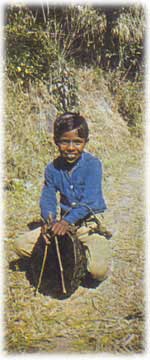 A Baadi Boy
|
| Instruments
Drums are the most distinctive hill instruments, including the hourglass-shaped hudko (played by Hudkiya) and the dhol. Flutes and string instruments (violin/fiddle) also accompany the Himalayan folk singers. The ghungroo, accordion, and bagpipes can also be heard. Bonus Link: Dying Beat of the Uttarakhand "Dhol" Women's Voices Songs telling women's stories are often sung by men. These songs can be sad and poignant, and are perhaps the most revealing about the difficult lives of hill people. Some are about loss, hardship, and conflicts, and others of longing, often of husbands and children who never send letters home (hint: write or call your mother!). Bonus Link: The Woman and Her Song in Himalayan Garhwal |
|