
Demographic Information

Significance: Uttarakhand's relatively low population as compared to the rest of the Uttar Pradesh mega-state has politically marginalized the hill people, allowing them to be exploited and easily ignored by the nation's elites. Significance: Most of the population is clustered in river valleys. If this were taken into account, the actual high population density and consequent land pressures would be revealed. Private Consumption: avg. Rs.21-26 / month Significance: The people of Uttarakhand have remained very poor, despite the region's tremendous natural resources. This is in large part due to its neo-colonial relationship with the rest of India that has continued and even accelerated since independence. Significance: Uttarakhand's forests are heavily exploited by outside commercial interests. What little is left to the locals is stressed beyond the breaking point. This is one of the main factors that prompted the Chipko movement where the people struggled for their forest rights. Significance: OBC-dominated state government in 1994 wished to enforce the extension of the 27% plains OBC quota to the hills where the OBC population is less that 2%. This prompted an outcry from hill people who are already deprived of employment opportunities in their own land. Solutions ranged from regionally-sensitive quotas to including the Uttarakhandi people in the OBC quota. A quota of 23% for SCs & STs already prevails and is accepted by most hill people. Central Pahari - Garhwali, Kumaoni Significance: Although Hindi is fast supplanting the native languages of Uttarakhand in the urban areas, Garhwali and Kumaoni persist in the villages. The Central Pahari languages are so diverse that one valley can often not communicate with another differences in dialect. However, cultural and linguistic homogenization throughout India is threatening minority dialects and tongues with extinction. Hindi, Urdu, various dialects
Uttarakhand
Uttar Pradesh
Population: 6.0 million (4.3% of state total)
Population: 140 million (1991)
Area: 51,125 sq. km (17.3% of state total)
Area: 294,413 sq. km
Pop. Density: 94.4 per sq. km
Pop. Density: 377 per sq. km
Rate of Pop. Increase: 2.14%
Rate of Pop. Increase: 2.51%
Per Capita Income: $80 per year
(Indian poverty line: Rs.85 /month)Per Capita Income: $120 per year
(Indian average is $330 per year)
Forest Cover: officially >50%
(recent studies have found the forests at <28%)
Forest Cover: <18%
Caste Breakdown:
Caste Breakdown:
Languages:
Tibeto-Himalayan dialects, HindiLanguages:
In addition, Indian Census (1991) figures reveal the poverty of the region's people. 70% of the population live below the Indian poverty line against a national average of 46%. Subsistence farming employs more than 75% of the population and 71% of landholdings in the hills are less than 1 hectare in size. The impact of the money-order economy is seen in the fact that over 60% of Uttarakhandi families have at least one member earning a livelihood away from home. In a recent survey of Garhwali soldiers active at the Kargil front, 80% claimed they had joined the armed forces to escape poverty in their village.
| District | 1991 Population (in thousands) |
%Increase 1981-1991 |
1981 %female literacy |
| Chamoli | 441 | 21.15 | 18.34 |
| Dehra Dun | 1,104 | 33.24 | 42.03 |
| Pauri | 664 | 4.24 | 27.13 |
| Tehri | 575 | 15.69 | 9.42 |
| Uttarkashi | 237 | 24.74 | 9.17 |
| Almora | 824 | 8.85 | 20.27 |
| Nainital | 1,557 | 37.06 | 27.10 |
| Pithoragarh | 557 | 13.91 | 20.30 |
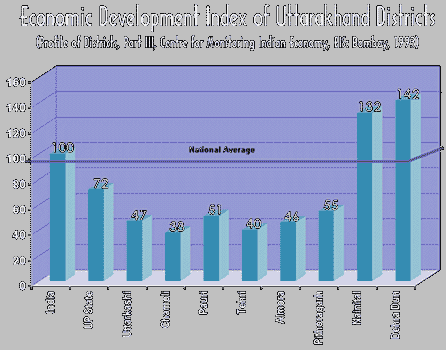
The Economic Development Index is based on several variables: population growth, population density, urbanization, literacy, work-force distribution, industries, manufacturing, construction, forest area, net area sown, agricultural productivity, infrastructure (post office, roads, railways), and credit (Bhatt, 1997).