Himalayas Awake!


|
UTTARAKHAND Himalayas Awake! |
|
| THE GUNS OF AUTUMN
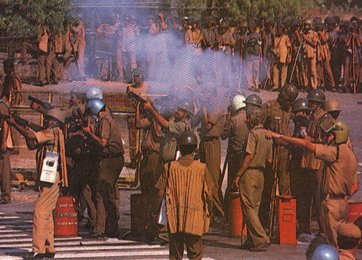
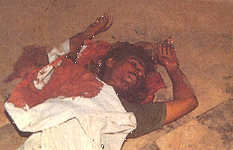
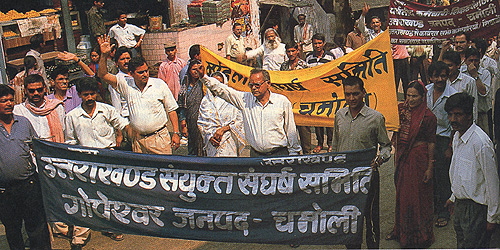
October 2, 1994, near a town called Muzaffarnagar, in the dry and dusty plains of northern India, Mahatma Gandhi's dream of a free and just nation turned into a terrible nightmare. On the exact day of the 125th anniversary of his birth, the non-violent freedom fighter's country fired on demonstrators, killing an unknown number of unarmed civilians. The police went on a rampage, molesting and raping women activists as they fled the scene of the atrocities. Yet the heirs to independence struggle, wily politicians who had ruled the nation since Gandhi's days, washed their hands clean of the massacre and gave little succor to their fellow Indians. In a cruel irony, a government of free and independent India, supposedly responsive to the people, repeated some of the worst excesses of British imperialism. The victims of this tragedy were a simple folk who lived in the vicinity of Hinduism's holiest peaks and shrines. Uttarakhand, the Himalayan region of India's most populous state, had long been neglected by central and state governments. Indeed, the hills had been severely exploited for its wealth of timber, limestone, and other natural resources, without much regard for the rights of local residents. Just as Gandhi and the founders of modern India had done before, the hill people had come together to demonstrate their right to exist as a people, to breathe the air of freedom, to lift themselves from poverty and desperation, to stop economic and environmental degradation, and to demand self-government. They wanted an end to the region's neo-colonial arrangement with the rest of India, a form of exploitation that has devastated the lives and land of the Indian Himalayas, akin to the colonialism of old. They did not ask for much. They had so little, not even a state to call their own. Despite living in one of the most beautiful and sanctified parts of the country, at the very source of the holy river Ganges, Uttarakhandis remained among the poorest people in the country. As such, both women and men, young and old, converged on the capital, to give voice to their grievances and to plead their case at the feet of Mother India. That so many were stopped so brutally, and women dishonored so violently, speaks to how something had gone terribly wrong with Gandhi's India.
It was during the height of the liberation movement that an Uttarakhandi battalion shook the very foundations of the British Raj by refusing to fire on unarmed demonstrators. That a state government of modern India could not spare their descendants from the bloodshed of state repression, stands out as an appalling affront to the memory of such a patriotic people. Uttarakhand's sons and daughters have consistently proven themselves to be among the most loyal and selfless citizens of their nation. Contributing perhaps the most men of any region to India's armed forces, Uttarakhand's sons have shared in many of modern India's greatest victories and suffered through her most ignominious defeats. Just as they had sacrificed their lives for the British in the terrible years of the Great War, Uttarakhandis fought bravely in all of India's wars subsequent to independence. Garhwali and Kumaoni troops have held onto their reputations as gentle soldiers aroused steadfastly to acts of extraordinary heroism. The women of Uttarakhand have through the decades suffered even more, but in their sorrow, had found new means to fight the system. It is they who fought the battles in behalf of the Himalayas' fragile ecosystem. By risking their lives for the trees, they bolstered a worldwide environmental movement, still in its infancy, by the example of their sheer determination and fearlessness. The wretched of the earth had proven themselves equal to the masters and their machines. The betrayal of these loyal hill people runs as deep as the giant clear-cuts and strip mines that have rent the Himalayas. Left to die by the thousands in the India-China war, ordered to clear militants from the Golden Temple in an inglorious operation, discriminated against by plains people, their forests pillaged by commercial contractors, and plight ignored by venal and corrupt politicians has worn the legendary patience of these highlanders. Year after year, they have pressed their case for economic and social justice through non-violent means. Year after year, they have been ignored and defrauded of their birthright. While conditions worsened, thousands more have migrated to the plains in search of menial jobs as servants. The hardship and tears of mothers, sisters and daughters, left behind in the villages by their dispirited husbands, brothers, and sons, have grown heavier with every passing monsoon. Just as gentle Parvati's despair climaxed in the birth of the fierce warrior goddess Durga, so may the suffering of Uttarakhand burst like a torrent across the plains of India. The Tehri Dam, now being built over the protest of Uttarakhandis, would unleash a tidal wave that would flood the plains, if ever shaken to its foundations by an earthquake. The politicians have made their decision to side with political expedience and power. It is up to us to side with the Himalayas and their people. And the struggle continues as it always has...
|